The Political Forum of Music
By Chloe Hofer
The political landscape of our world is relentlessly disillusioning, marked by inordinate violence and deepening polarization. Yet, musicians have been responding, particularly at the Grammys, as Bad Bunny, Billie Eilish, Joni Mitchell, and Olivia Dean spoke up against ICE and President Trump’s immigration policies. Appealing to our common humanity, musicians have reaffirmed that music has and will always be a powerful tool for protest and political change, capable of reaching diverse audiences, changing our feelings, and evolving with us as political conditions change.
The earliest origins of political ballads appear in enslaved communities in the United States. Songs were not merely for recreation and work, but included religious and social commentary. Even in the most traumatic of experiences, music helped those in bondage cope with the trauma as well as work towards their freedom. Since most enslaved people were illiterate, music became a covert communication network, sending signals, through biblical metaphors and lyrics, for escape through the Underground Railroad. Music was a way for these communities to connect with their heritage, and more than anything as a refuge, emotionally and physically.
After the end of the Civil War in 1865, these spiritual and work songs eventually transformed into jazz and blues. The emotional and political core remained intact, as themes of endurance and liberation continued into the 20th and 21st centuries. The very heart and core of many genres find themselves owing recognition to enslaved people’s perseverance, strength, and creativity.
In the 20th century, protest music was explicit in its commentary, as the music of Sam Cooke, Bob Dylan, and Tracy Chapman embedded civil rights discourse into their sound. Cooke’s ‘A Change is Gonna Come’ is arguably the most famous protest song. Released in 1964, Cooke was inspired by Bob Dylan’s ‘Blowin’ In the Wind’ and black gospel. The song follows his life struggling as a Black man in America, dealing with segregation and violence across the South, and yet the song breeds hope that change will occur in the United States for people of color. As Rolling Stone Magazine calls it, “one of the most powerful indictments of racism ever recorded – an unparalleled moment in the fusion of pop music and progressive politics.” Cooke defined the soundtrack of the Civil Rights Movement, distilling a passionate need for change in his sound.
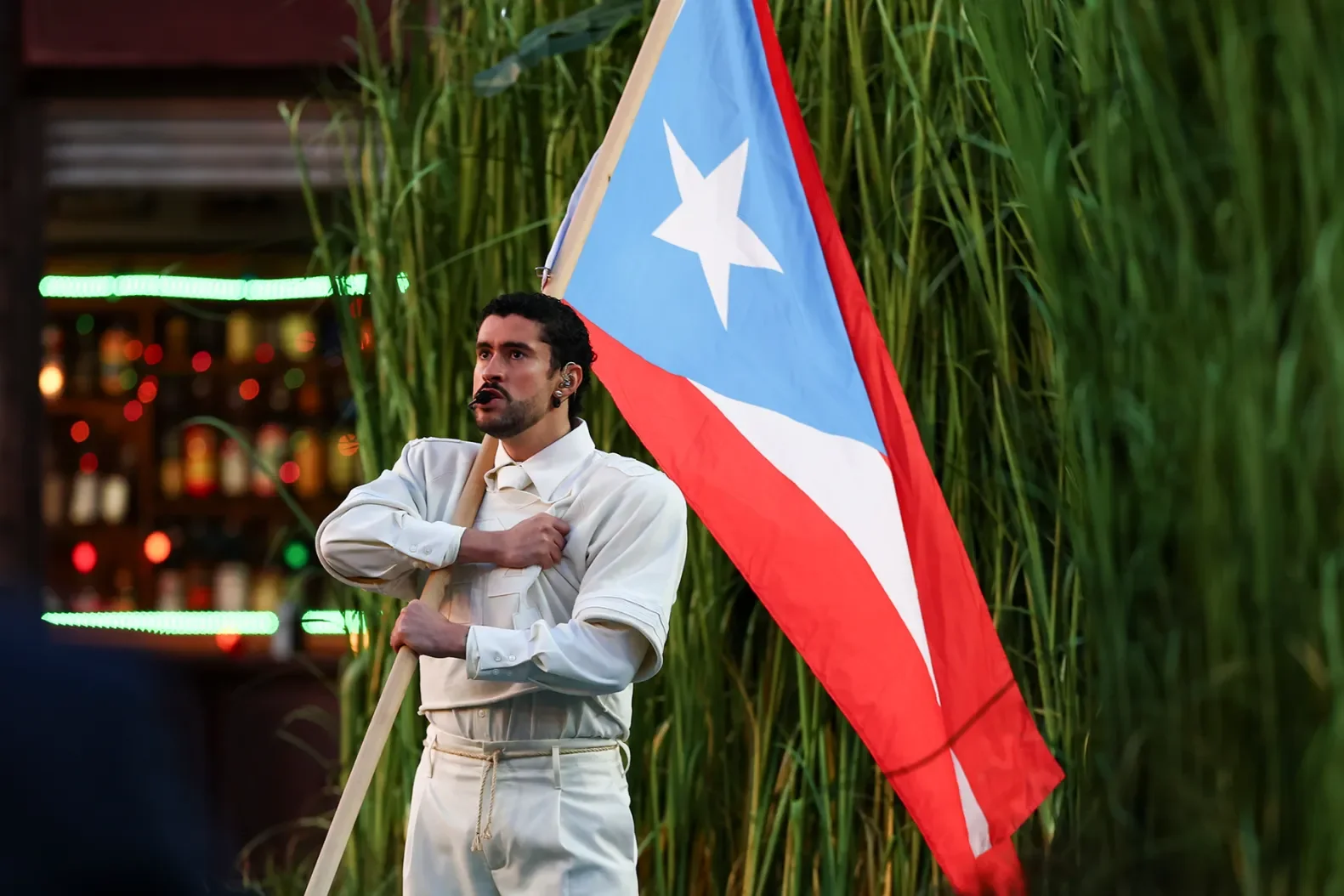
In a time in which we feel so politically disconnected from each other, music reminds us of our shared humanity. In particular, Bad Bunny is one of the most prolifically political musicians in popular culture. Even prior to his performance at the Super Bowl, Bad Bunny has imbued much of his music with feminist and anti-colonial messages, using his platform to inspire movements. In 2025, he released ‘LO QUE LE PASÓ A HAWAii’, a song about American colonialism in Puerto Rico, displacing people from their lands, “They want to take my river and my beach too / They want my neighborhood and your kids to leave.” Arguably, his most explicitly political lyricism, he touches on the realities of cultural erasure and the prioritization of profit. Yet, at the 2026 Superbowl, he did not leave behind his political motivations, and worked to highlight how music can connect with us all, despite language barriers.
As the first Latino artist to take the stage, he brought a message of unity to America, evoking vignettes of real people throughout Latin communities. It was more than a performance but a story being told about real communities strewn across the Americas. As the granddaughter of a Cuban immigrant, my entire family saw themselves in the storyline across the stages, from the sugar cane field to the dominoes game to his little casita. He performed ‘LO QUE LE PASÓ A HAWAii’, along with familiar favorites such as ‘DtMF’. The performance was a reminder of the importance of the connection we have to each other as people, ending with the message “The only thing more powerful than hate is love.”
While political landscapes may shift, the role of music endures in our lives and for generations on. Music remains one of the few spaces where empathy can be felt and shared, and where change can be imagined again and again.