
Swans at Electric Brixton
By Jakub Brzozowski
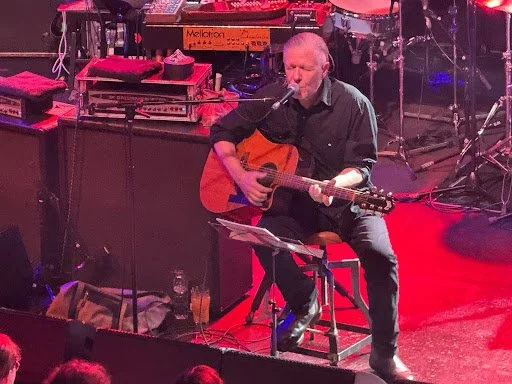
According to the press releases and various statements made across interviews by Michael Gira, Swans Will Be Dead (again) after this tour, at least in the so-called “Big Sound” incarnation of the band, which was splintering fans’ ear drums since 2010. I needed far less convincing, so finding myself in Electric Brixton located in the vibrant neighbourhood of (you guessed it) Brixton in London for two consecutive November nights was a no brainer.
London is a city that carries a lot of history for the band. Briefly speaking it was the place where Swans first found some relative success during their initial run in the 1980s. In their native New York City, apart from some experimental music nerds and the modest (only in size) ex-no-wave audience, little attention was paid to the group. London, on the other hand, was the worldwide capital of the post-industrial scene, where audiences keen on experimentation awaited anything that could be labelled as industrial, that including Swans. More concretely, in the band’s biography Sacrifice and Transcendence: The Oral History (penned by Nick Soulsby), Edwin Pouncey recounts: “I first saw Swans live at the University of London in 86’ […] and it was packed – they’d done a good job of getting people in there.” In comparison, Mark Harris states: “Then we were up at the Limit club in Sheffield, and there were only about thirty people in there. […] There was a massive difference between playing in London and anywhere else.”
Speaking of those 1986 London shows, quite infamously, a gig that took place in the Institute of Contemporary Arts on the 27th of March was recorded and subsequently released as Public Castration Is A Good Idea, definitely one of the most abrasive live recordings of a rock concert. Its cover art is an iconic staple t-shirt design up to today. Given that many historical connotations, it felt that the shows were not just special because it’s “the last tour”, but because it’s a very important stop on the said tour.
Both of the shows were opened by a meditative ambient set by Jessica Moss. The audience (apart from those queuing for the merch or spellbound by the bar) seemed captivated and completely entranced by the minimalistic sounds conjured by Thee Silver Mt. Zion Memorial Orchestra’s violinist. Personally, I found the set on the second night far more compelling than the first one. It’s not because of the varying quality of the performance per se, rather during the first gig I was too excited to see Swans after almost a two-year break, and I stood too far from the stage to maintain focus necessary to fully internalise these sounds. This music is meant to be experienced, collectively, but in isolation: standing in the crowd with your eyes closed, and allowing yourself to be enveloped by waves of sound.
It's very noteworthy that for a show as intense and noisy as a Swans concert is, the support act presents a delicate ambient set. Such an atypical move (after all, you usually expect the headliner and support to align musically) is a staple of Swans’ tours post-2010 reactivation. The main role of the support act is to warm up the audience awaiting for the main course. From this angle, a minimalistic set concerned with absence rather than omnipresence of sound, which is the defining characteristic of the New York Downtown’s ensemble, allows the audience to clear their headspace before the anticipated onslaught begins.
This effect wasn’t lost as Swans started just 15 minutes after Ms. Moss finished her suite, and they thrived off that momentum to the fullest extent possible. The opening song, ‘The End of Forgetting’ was everything you’d expect from modern day Swans. This forty minute epic evolved from a simple one note staccato pattern played by Michael Gira into an all-encompassing orchestra of sounds, with the whole band feeding into the groove and manufacturing this almost tangible wall of sound. Vitally, it wasn’t cacophony, but rather a transparent, albeit overbearingly loud mass of sound, in which the audience members could discern every single instrument’s performance and how it contributed to the overall effect. It then devolved into an acoustic section with the frontman’s singing and lyricism as its central focus, without losing the whole band’s contributions, who helped to generate volatile ambience making this part unique and memorable. After going on like that for a while it just naturally stopped… after 40 minutes, which passed in an instant.
The formula of contrasting loud with quiet and melancholic used in that song works well for three reasons. First, in general, contrast is just a very good method of creating art. Second, Swans constantly maintain both the intensity and the overwhelming atmosphere. It’s a given in the noisier parts, but the acoustic ones retain the grit (especially lyrically). Finally, the crucible from which both sides of the bands’ music grew from is the same: 20th century “old” American music. The loud, repetitive parts always have a bluesy undercurrent (one of Gira’s favourite bands is The Stooges) translated into the realm of noise rock, while the acoustic parts are radiating hard-headed outlaw country. All this amounts to a singular and coherent vision of the music. That was my exact impression all throughout the show – it wasn’t just contrast for its own sake, combined with awkward transitions; it was simply a chunk of music, which only made sense when its parts were mixed.
Speaking of mixing: the next on the setlist was The Merge, the only representative of Swans’ last “Big Sound” offering – Birthing. This one was a different beast, groovy as ever, and required two basslines being played simultaneously. While Christopher Pravdica (bass) was endlessly making his way through a crawling three-note pattern, Dana Schechter complimented it with some lead lines on the lowest string. This was coupled with a hypnotic drum groove played on two drum kits, with Larry Mullins complimenting the main drum part with accents on a hi-hat cymbal. The tribal atmosphere was enhanced by Michael Gira’s frenetic dancing and stage moves (our good old friend Iggy winks again). He did really look like a man possessed by the rhythm, which his colleagues formed together. It then segued into Swans’ typical groove oriented soundscape exploration and continuously expanded as Gira danced chaotically in front of his bandmates, enticing them to keep up the intensity on their instruments. For the last part of the number the groove toned down, letting the song naturally dissolve, only this time it was a shorter cut, lasting for… 30 minutes.
In spite of Swans’ unyielding formula of playing new stuff live in an ever-fluid way and allowing for as much improvisation as necessary, old songs did form a good portion of the material played in the set. ‘Paradise Is Mine’ from their penultimate album The Beggar (2023) was met with an enthusiastic, albeit measured response. This reinvention warrants – if not for the lyrics, I would have never recognised the song. Still, it remains a more meditative song, lacking the tension release which the outbursts of noise so eagerly generated by Swans provide. In a way it’s an exercise in patience, because the steady tension growth in this song manifests itself both instrumentally (uneasy, but mild and acoustic instrumentation), and to a larger degree – lyrically. With lyrics such as: “Is there really a mind?” or “Am I going to die?” muttered repeatedly by Michael Gira, you’d expect a cathartic release of noise, which is just not there.
On the other hand, I think the most ecstatic (not transcendental, we’ll get there) moment of the show was at the beginning of ‘A Little God in My Hands’, a well-known cut from now classic 2014’s To Be Kind. The loudest “woo!” of the shows happened exactly when Chris Pravdica and Philip Puleo (drums) locked into that monstrous bass-heavy groove and, I’ll admit, this number was probably my favourite part of the show too (mostly because it happens to be my favourite Swans tune). This impression was surprisingly faithful to the original, almost unlike anything else that the band is doing. Part of that might be attributed to the fact that it’s an old song, but nevertheless, the execution was as brilliant and immediate as ever. Even though I did feel the lack of that dissonant trombone noise in the crescendos – Norman’s Westberg noise generator, also known as, electric guitar hit the right spot and the live rendition of this noisy punk blues masterpiece was certainly the most energetic part of the whole gig.
The last song performed both of the nights was “Newly Sentient Being”. Along with the first number, these two have clipped the set together as unreleased songs, which are still morphing in a search for their final form. It started as usual with a slow build, uniquely with Phil Puleo playing a hammered dulcimer. As one might expect, the grove eventually amassed into a pulsating wall of sound, with Gira masterfully controlling the dynamics of the buildups. As the crescendo rose, Gira bowed and reached ahead with his hands towards the audience. Almost everyone on the ground floor copied his move, and it was just one of many instances where you could feel like you’re at a cult gathering with fellow music devotees, rather than a rock concert. After that, the song returned to its initial section, which was followed by a groovy section with a notoriously post-punk bassline. It was then interrupted by a ‘drum solo’, where both Larry Mullins and Phil Puleo played an endless snare roll with Gira orchestrating their dynamics – a testament to the tightness of the band.
The song concluded with what is most probably my favourite section of the concert and one that surprised me the most. It’s just the bass and the drums (the rest of the group produced background textures) locked into a bassline that was bluesy, but dirge, at the same time. A masterful ending for a show and for saying farewell to the band. With somewhat optimistic lyrics (which still indicate closure): “There is light, there is night” repeated endlessly, the song had one little bit to offer – harmonica. Midway through the section, the frontman played the most elegiac harmonica solo , which was as country blues as it gets. And with that the concert was done – “Thank you! Lights up!” said Gira – and as were Swans for Londoners.