
A Shoegaze Stream-of-Consciousness
By Alexia Heasley
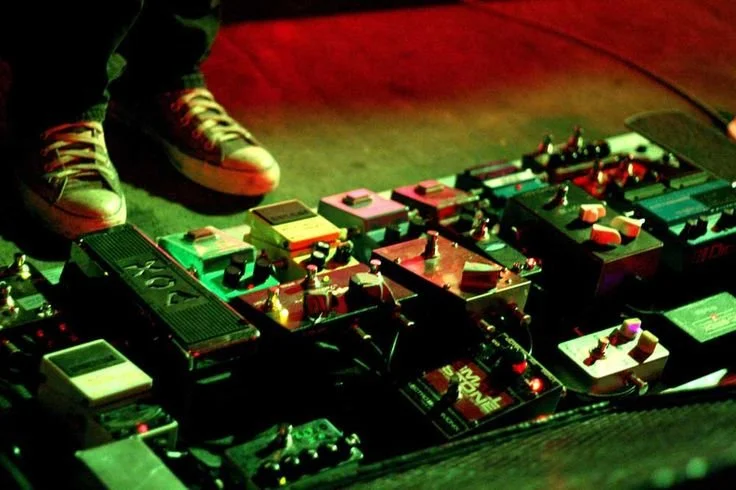
Drifting between the hum of distorted guitar pedals and the whispered ache of half-heard lyrics in 1990s Britain, shoegaze emerged. The genre claims its name from the press, who mocked the musicians for staring down at their feet during gigs and sacrificing stage presence for sound. The attention given to the creation of music rather than its live reception became the very pride of the genre, using guitar pedals and distorted amp settings to create a “wall of sound.” Shoegaze represents the emotions we feel before we find the words to express them, thoughts before articulation, the very equivalent of Virginia Woolf’s unpunctuated musings, or James Joyce’s dissolving of the boundaries of language to reveal the raw hum of consciousness beneath. Eighty years prior to the shoegaze revolution, these modernist writers had come together to create stream-of-consciousness writing that allowed their words to mimic their minds, creating a wall of thought. To understand the literary kinship between shoegaze music and stream-of-consciousness writing, one must understand that there was method in their downward gaze. Beneath the curtain of hair and warbling sounds, the musicians were creating music that mirrored the human experience. The overlapping guitars and airy vocals are clashing and winding thoughts while the drums pulse beneath like a forgotten heartbeat amidst the noise of the mind. The lyrics take on a hidden layer of consciousness, a dream-like state that is not fully understood but felt and inhabited.
Both genres are rebellions against clarity, emphasising the layers of consciousness that make up a whole, not only the immediately visible. The artists distrust simple sentences and clear melodies that fail to capture a reality which never unfolds in rhythmic paragraphs and 4/4 hooks. Reality for these artists is a haze of impression and half-thoughts that makes them devoted to the beautiful blur of their craft, the confusion that is perception. The obsession is not with what happens but how it feels to experience it. In Woolf’s The Waves, six voices ebb and flow through the narrative, colliding in a symphony of clashing worlds. In My Bloody Valentine’s Loveless album, the guitarist Kevin Shields achieves a similar collision of sounds as the guitars become so distorted they melt into each other, submerging the vocals under the tide of noise. Where Joyce filled pages with unpunctuated, unfiltered thought, Shields filled rooms with unfiltered feeling and textured sensation. Their work was never linear but always flowing. Each chord change a shift in consciousness, every reverbing trail an ellipsis, every feedback swell an emotional aside. If Woolf sought “moments of being,” the musicians sought moments of sound, suspended instants where everything blurs together to present something clearer than they had heard before.
Reverb is used the way Woolf used repetition, a suspension of time that lets the moment stretch and linger, playing on the mind. In Slowdive’s Alison, each chord is an implosion, leaving a trace of itself behind, a thought you aren’t ready to part with that clashes against everything else on your mind. All the while, the vocals, a murmured narration of outer life, are swallowed by the surrounding sounds, drowning out Neil Halstead’s preoccupation with sinking.
Shoegaze becomes a literary genre in disguise, discontented with simply telling you something, but urging you to feel the act of thinking it, as the modernist imagists do. The focus is on perception and reception, using their crafts to prompt a reaction in their listeners and readers. Stream-of-consciousness writing blurred the boundaries between self and world. Joyce’s Ulysses makes it a struggle to distinguish Dublin from the consciousness of Leopold Bloom. In shoegaze, the hum of the music is the mind externalised, the reverb a chamber of consciousness. The musicians and their listeners connect and merge in a wall of noise, made possible through the music alone, rather than the ego-driven stage presence of a band’s front man. The genre relies on a deliberate erasure of ego, while the extravagance of rock’n’roll, recognisable by its grandiose solos and distinctive anthems, is a far-distant cry. Shoegaze is anti-rock in its humility and rejection of hierarchy. The band members are equal to each other and to their audience. The voice is an instrument no more important or dynamic than a delayed guitar or the soft hiss of a trailing cymbal.
Humility allows for musical intimacy. In the blur, we find ourselves. The listener becomes the author, invited by the absence of clarity to fill in the missing words, the obscured notes, the spaces where the song dissolves into pure texture. As with Joyce or Woolf, listening to shoegaze demands participation.
While stream-of-consciousness writing arguably still lingers in more recent texts, it has mostly been lost to the burial of modernism that made way for a postmodernist literary revolution in the 1950s and ‘60s. Shoegaze, on the other hand, was not buried at the turn of the century. Its ghost continues to hum through modern music, haunting the melancholy melodies of Beach House and the introspection of Cigarettes After Sex. Some pop artists may even be caught flirting with the shoegaze ethos, undermining clarity for echo and ambiguous lyricism. The inherited practice is not just a sound but an attitude towards consciousness. In an age of algorithmic precision, shoegaze takes radical action in its commitment to ambiguity. Shoegaze, like consciousness, resists conclusions. It lingers, dissolves, and then returns in an echoed, distorted hum long after the track ends, a thought that refuses to settle.
Allowing yourself to sit with the music and let it drift into your thoughts makes the sound reverberate softly into the endless, echoing now. Though arguably a bit formulaic in a way only the artists are ever fully aware, the rest of us are invited to get lost in a shoegaze stream of consciousness.