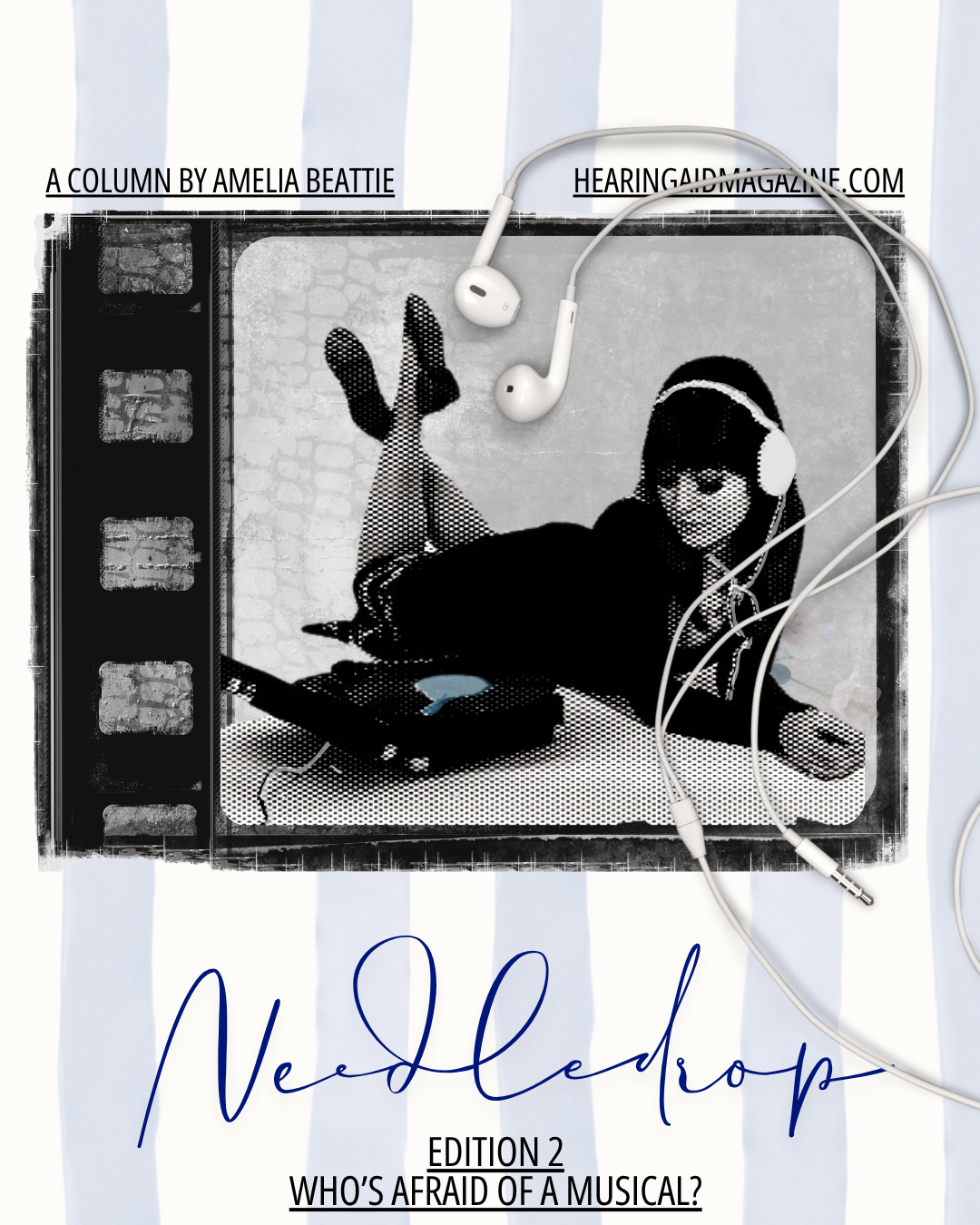
needledrop: Who’s Afraid of A Musical?
By Amelia Beattie
In a 2018 interview with Coup de Main a pre-brat summer Charli XCX notoriously proclaimed: “I hate musicals SO MUCH. Honestly my skin crawls [...] I just hate them [...] I hate that shit so much.”
A critique harsh enough to have any open thespian clutching their jazz shoes indeed. Charli’s statement demonstrates two key facts which you probably already suspected:
Charli XCX does not mince words.
Musicals are not cool.
But what did the musical ever do to us? How did it fall out of favour so aggressively? And how do we revive it? For this month's Hallowe’en special of Needledrop, we will unearth the return of the movie musical from beyond the grave of the golden age of cinema.
Until recently the movie musical felt decidedly dead. A relic of times past that may as well have been laid to rest with the other starlets in the Hollywood Forever Cemetery. But once upon a time the movie musical was the favourite child of the studio system. Cinema’s first foray into synchronised sound was immediately seized by the genre with The Jazz Singer (1927), a hugely significant (and horrifically racist) step forward in cinematic history. With the technology to support it, audiences and studios took musicals and ran to the box office. The release of The Wizard of Oz — as well as securing a place in the Christmas Day T.V Guide for the rest of time — was one of the most well-attended theatrical releases, and most watched films of all time. Some newcomers in the animation scene by the name of the Walt Disney Company even ventured into feature length films with the musical format of Snow White and the Seven Dwarfs (1939).
Throughout the 1950s studios and actors made their names adapting the rich catalogues of theatre legends Rodgers & Hammerstein with classics such as Oklahoma! (1955), Carousel (1956), and The King and I (1956). Films of the 50s didn’t only play host to existing properties, but became the crucible for full scored studio originals such as 1952’s Singin’ In The Rain. The beloved film could hardly be a true original score though; Singin’ in The Rain was a picture frankensteined together by pieces of the MGM musical back-catalogue, with its titular number first gracing the silver screen in The Hollywood Revue of 1929 (1929, shockingly). Singin’ in the Rain's conception was very much music first, as screenwriters Betty Comden and Adolph Green built the plot of the film around the score’s 1920s origins. But the film’s plot, which follows the transition to the ‘talkie’ feature and the dawn of the movie musical, was built on something stronger than historical convenience — nostalgia. Perhaps the romanticisation of an era of film not 3 decades prior to its own is just the kind of over-sentimentality that makes people turn the showtunes off.
Sentimentality is indeed the word for the swooning and sighing soundtracks of the golden age studio musical. The brass crescendos, indulgent overtures and luscious string arrangements could not wear their hearts more on their sleeves and in your face. Nowadays, we might think that the music of films like Singin’ in The Rain as the pinnacle of showstopping, toe-tapping, campy showtunes, but it is important to remember that it did so to harken back to an even purer form of the genre. The rosy-eyed nostalgic projection of the past only proves that Hollywood and the stars within it have always been a little in love with themselves. But nostalgia for nostalgia's sake can only take you so far. At a certain point wistful homage becomes a self-cannibalising medium that demands a bit of innovation.
Today’s view of the movie musical – an at best saccharine and at worst cringe-inducing medium derivative of a time many would rather leave to rot. It also doesn't help that the values and settings of the ‘simpler time’ depicted by the so-called ‘golden age’ of the 1940s and 50s don’t inspire much to sing and dance about anymore. Whilst Singin’ In The Rain remains a beloved ghost, it is of an era no one wants to take seriously anymore. It appears that in our jaded post-brat age, no one can afford to be caught being sincere.
How then did the likes of La La Land (2016) manage to break the curse of musical cringe to dominate the awards season and the ‘top four’ of any sap you know with a Letterboxd account. After all, the Damien Chazelle romance is unapologetically musical — it opens with a full-ensemble choreographed dance number for God's sake. Unlike Singin’ In The Rain though, La La Land benefits from a little more distance from its source material. The credits have long since rolled on the days of the golden age and the reign of the studio system. La La Land is unashamedly wistful for an era which by this point has passed it by, and this is where the magic of it lies.
The fantasy of La La Land resuscitates the dreams of the golden age of musicals; the hope of having the chops, of being sincere, and making it the old fashioned way in Hollywood. Never is this hope more earnest than in ‘Someone In The Crowd’, a number positively dripping in enthusiasm and entirely overzealous in its ambitions of success, with all the dramatic overtures of any broadway anthem. La La Land succeeds in its gentlest moments too. Ryan Gosling’s audition as an old fashioned crooner in ‘City Of Stars’— though not quite Gene Kelly— is an irresistible bit of score, able to soften the heartstrings of any musical cynic. It is this embracement of the abandoned sincerity of its predecessors which confirms La La Land’s legacy.
The closing scene of the film with Mia watching Seb open his jazz club (spoiler for a 10 year old movie) playing a rendition of their own ‘Mia & Sebastian’s Theme’ allows her to envision the life they could have shared in glorious technicolour, and embraces wholeheartedly the sentimentality of the silver screen. Justin Hurwitz’s homage to the genre dares its listener to imagine a life and love big enough to fill the studio backlots of a good old fashioned musical, or perhaps even burst into song.