Muna’s ‘gets so hot’ tour
By Joseph Wear
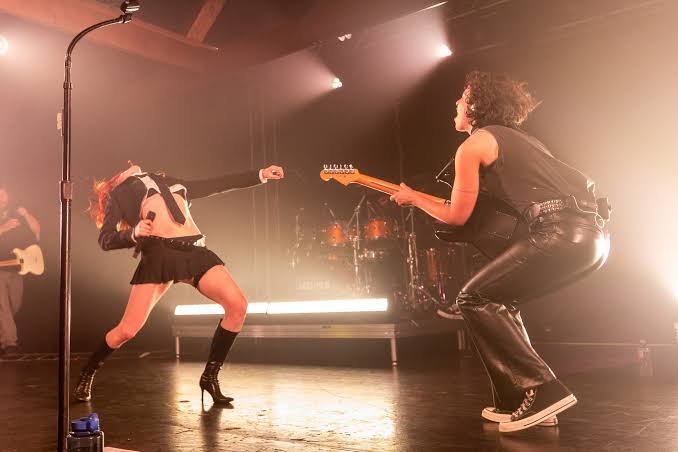
On Friday 13th November, MUNA stopped at the O2 Academy in Glasgow on their ‘Gets So Hot’ tour, an ironic name considering it was a very chilly, very wet early winter evening. Luckily for us, the trio, consisting of Katie, Josie, and Naomi, brought over the city heat of Los Angeles to provide an hour and a half of swelteringly thrilling electronic pop bangers. Supporting their fourth studio album Dancing on the Wall, MUNA came on stage intent on delivering a show translating the feeling of a sweaty gay nightclub, complete with dancing until your feet hurt, singing until your voice dies, and being surrounded by community. What I experienced in that room became something almost sacred, as each song brought me closer and closer to queer freedom.
The show kicked off with a rundown of the album’s setlist, reordered to better suit a live audience. The triple punch of ‘It Gets So Hot’ into ‘Dancing On The Wall’ into ‘Wannabeher’ sets the tone incredibly, showcasing the high-energy pop MUNA are known for at its greatest. It did not take long for the crowd to get warmed up, clapping and singing along three songs in. Before the trio sang ‘Big Stick’, a song critiquing the domination of governmental power, they make their political stance clear: “Fuck Trump, Fuck The Right, and Free Palestine”, which was met with rapturous applause. If it isn’t clear, MUNA are an all-queer pop band, a quality they do not shy away from in their music and at their shows, where they frequently flirt with each other on stage. Keenly aware of the political and social implications of what their presence stands for in our modern world, MUNA’s pop music is a celebration of being yourself and queerness in all of its messy, romantic, sexual, heartbreaking, radical forms.
The second half of the set primarily consists of deep cuts and fan favourites. Going from ‘Kind of Girl’, an ode to being ever-changing that the band dedicates to the trans community, to ‘Taken’, a country-infused anthem about cheating; MUNA situates themselves as a voice for all kinds of queer expression. The setlist, before the encore, ends with ‘Eastside Girls’. The mission statement of the album, the song is dedicated to the band’s hometown by lovingly poking fun at the queer scene of Los Angeles. The anthemic bridge, an eclectic list of places, people, and things, is almost curated to induce a screaming hoard repeating it back and ends the set on such a high that you’re begging for more.
With the rise of streaming platforms, and concert culture itself becoming an internet niche. It is not difficult to find playlists of any show’s setlist, allowing you to familiarise yourself beforehand with its runtime and progression. A consequence of this knowledge is that you can often be counting in your head how far through the show you are, or how many songs stand between your favourite song. MUNA were so electric that I had no choice but to forget the setlist I knew and live in the moment. That is the sign of a well-curated show, and a successful live artist. The trio performed with such intent,and such strength, that you were enraptured by their presence. They clearly wanted to be there, were entirely in the moment, and understood the evening they were providing for their audience. It was very special to witness and be a part of, at the risk of sounding too melodramatic.
The concert ends, officially, with perhaps MUNA’s two biggest songs: ‘I Know A Place’ and ‘Silk Chiffon’. ‘I Know A Place’ is a track about finding your people and finding a space where you are free to be 100% yourself, and ‘Silk Chiffon’ (a feature with Phoebe Bridgers, whose part was sung deliciously by Naomi in her absence) is a cheesy love song about a girl. What both of these songs do, positioned right at the end of the show, is send out MUNA’s message as loud as possible. Queer people deserve joy and love, especially at a time when queer rights and laws are being challenged and rescinded at a rapid pace. My friend and I arrived at the concert a little bit early, and had the privilege of watching the crowd arrive. I was struck by the sheer range of queer representation in attendance – all genders, all ages, all expressions. It was the most expansive group of queer people I have ever seen in one place. That unification is the power of excellent pop music. While some may discount the genre as trivial , this concert suggests otherwise. Pop music brings people together, provides them with an opportunity to forget their troubles for a time, and dance.
MUNA have maintained a similar, niche audience throughout their career. This allows their shows to remain intimate, providing an opportunity for a deep connection to be made between them and their audience. It makes the concert feel more like a protest against the attempts made to silence queer people. Protestation is just as powerful when it is a celebration of joy, and MUNA’s stop in Glasgow was undeniably joyful.