
Lessons in Music: Southern Rock
By Ian Glackin
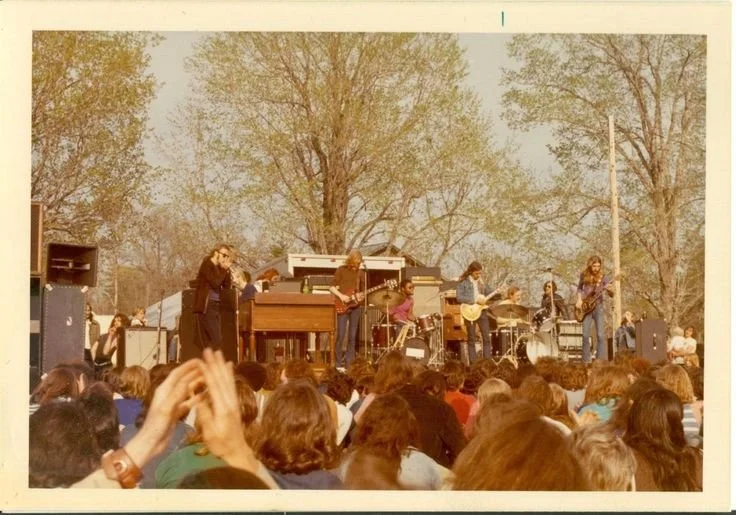
I love Southern rock ‘n’ roll. The soaring vocals, collaborative atmospheres, and contagious grooves have hooked me completely in the last couple of years. One of the great joys of my musical journey has been the exploration of rock ‘n’ roll from the high 70s, for my own edification and growth as a player. The genre offers an endless bounty of material to study, due to a few key characteristics that aren’t necessarily unique to Southern rock, but are significantly more prevalent than in other subgenres of rock.
The first is the simplicity of the structure. The most common chord changes in Southern rock revolve around the world of the I-IV-V, which is the central ethos for the world of rock ‘n’ roll. This simple progression was born in the Delta, before traveling north to cities like Chicago and Memphis, playing its part in musical movements across the Western World. However, Southern rock also showcases a couple other simplistic progressions, like I-bVII-V, that facilitate improvisation in a major key, which has helped me integrate major pentatonic instinct into my soloing. Now of course the idea of having a bag of major and minor licks to go to did not originate in Southern rock, but solos across the genre are full of examples to learn from.
Southern rock also benefited hugely from the technological boom of the recording industry that occurred in the previous decade. An entire new generation of musicians came onto the scene right around the time that multi-tracking (specifically 16 track recording) was becoming the industry standard. Such innovations led to higher potential in the studios, as more instruments could be recorded at an articulate level. Transitions like this led to bigger bands, with more intricately recorded songs, and just more sonic/musical activity in general. Bands began to reach new ceilings of recording capabilities, integrating distinct horn sections, four guitars, pianos and organs, multiple drummers, and a chorus of backup singers into their work. Thus, the musicians of Southern rock (especially guitarists) had to make a habit of occupying less sonic space, which manifested in some great examples of rhythm guitar playing that we otherwise might not have gotten. For anyone who wants an example of what I’m talking about, put on Little Feat’s ‘Two Trains,’ and then open your iPhone settings and navigate to Accessibility, and then scroll to Audio/Visual and move the audio balance all the way to the right side, and you’ll hear a great little rhythm part by the band’s Paul Barrere. Parts like this aren’t immediately noticeable, but they’re absolutely essential. The bands of the 70s were some of the first to have the opportunity to harness the full power of the recording industry’s technological offerings, and Berry-esque guitar playing was no longer the dominating option for rhythm players, since they’d be drowned out by everything else going on in the song. With the technology at my fingertips to dissect songs to their individual parts, I’ve been able to grow significantly as a complementary musician from studying the players of the Southern rock movement.
Finally, Southern rock draws a lot of its defining characteristics from jazz and blues music, one of them being its accessibility to players. Southern rock is not difficult to understand – anyone with a bit of musical instinct and an intermediate understanding of their instrument can hop in on a Southern rock jam, in the same way that one would do for a blues jam. Like I said earlier, everything revolves around a couple of progressions and a few scales. It’s really easy to follow and play with other people, while allowing for improvisational growth. I’d say it’s a tad more interesting in structure than your average blues song, but not nearly as demanding as jazz. Southern rock is designed to facilitate good times, and it can teach young musicians how to jam with other people in ways that other subgenres of rock might not be able to.
Being able to draw influence from all corners of recorded rock ‘n’ roll has given me a more complete understanding of my role in the genre, and it’s allowed me to adapt to musical situations that might not require the same things from my playing. That being said, I’ve learned to fake my way through a lot of things with a couple of tricks that I’ve learned from the players of the 70s. And if you can make everyone else think that you know what you’re doing, you’ll do just fine.