
In Conversation with Picture Parlour
By Evelyn Donnelly
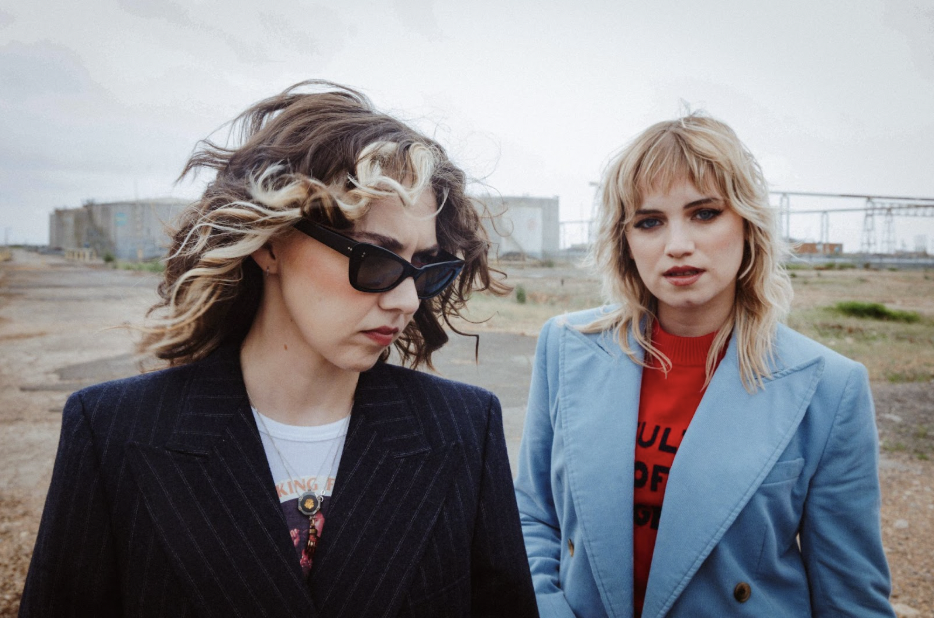
In the small, haphazardly decorated green room at the Cabaret Voltaire, a small venue in Edinburgh, I sat down with the two frontwomen of the indie rock band Picture Parlour, Katherine Parlour (vocals and guitar) and Ella Risi (guitar) before their gig. Over a couple of cans of Innis & Gun, we chatted about their first album due for release on November 14th, their relationship with live spaces and communities, and their visions for the future.
…
This interview has been edited for length and clarity.
Hearing Aid (Evelyn Donnelly): Your first album, The Parlour, is coming out in November, which is so exciting. What is the kind of sound and energy you're going for with the new album? I mean, I know you've already released a couple of the singles from it.
Risi: It's kind of got like a little bit of everything we sort of tap into. Like it has the big kind of–
Parlour: Glam rock.
Risi: Yeah. Like T-Rex inspired moments. And then like, we have our ballads. We love a ballad.
Parlour: Yeah. I think it's just big, big kind of like rock indie, but I suppose theatrical. Gone down that route. Just big, ambitious, unapologetic sound.
HA: What are your favorite songs from the album, would you say?
Parlour: There's a song that's like, it's our next single fuck. I suppose we could say it doesn't really matter. It's called ‘The Travelling Show’ and it's the final song on the album. And it was not supposed to be a single, everyone was like, “oh, it's a ballad.” It's like a power ballad. So everyone was like, “you don't need to do that as a single,” but we just love the song so much that we were like, it has to have a moment. So that's my favorite song on the album for sure. Yeah. ‘The Travelling Show’.
Risi: And that was a very sort of Bowie inspired tune, which we love.
Parlour: What's your favorite?
Risi: My favorite is probably one that we play live. It's called ‘24 Hr Open’. We're playing it tonight. And I think just because it's one of the most fun to play in the set. I can't wait to have that out. Also probably ‘The Travelling Show’ as well.
HA: Since your first debut show at the Windmill in 2022, your gigs and performances seem to be a big part of your relationship as a band and your experience. How would you say that has changed over the years?
Parlour: I mean, it's weird. Because when you perform, you kind of switch off and almost don't exist for half an hour or an hour, however long the show is. But it's when you watch things back, that's when you realize the change, the transformation we've had. It feels the same as it did in 2022 or when we were both in separate bands in 2018 and we kind of knew each other, but played separately. But I think as songwriters and performers, we've just improved. I guess you get more comfortable on the stage. That's something like when you tour, like with this tour; first night: shit yourself, it's like, “God, I don’t think I can do this!” Like the second night you're like, “ah, I'm back in. I'm in the swing of it.” So, yeah, I think we've improved a lot and it's way more enjoyable now that we've got a record. Because we've got this thing that makes sense to us and we know that hopefully it's gonna be out.
HA: In such a digital age, what do live spaces and venues like Cabaret Voltaire mean to you and how is that reflected in the new album?
Parlour: Yeah. I mean, live spaces mean everything to actually all of us in the band. We all kind of grew up coming to venues like these back where I'm from in Liverpool, where you (Risi) are from in Yorkshire. Then when we moved to Manchester and then London, like every single town that we've visited, we've kind of found a community and a safe space in live music. And I know that with the digital age, you can get that on apps, but there's nothing more visceral than real life. Even if you walk through the venue right now, no one's on stage, but there's the smoke. You are walking through the smoke, you can feel it, you can smell it. That element of it is like magic to me. So live spaces mean everything, especially like Cabaret Voltaire and independent venues. It's literally the backbone of my youth and the whole industry.
Risi: How we met. So we literally owe everything to them.
Parlour: You were playing a show at the Castle in Manchester, which is an iconic independent venue, and my friend was in your band, and then that's why I was there that night and I was like, that guitarist is so good, we need to meet.
Risi: Especially right now, we have just come off the back of doing an independent venue tour, and with the struggle that they're facing at the moment now is the most important time to nurture them. I was speaking to the venue manager here and he was saying that Cabaret Voltaire is kind of having a moment again, they've been rebuilding it for the past year. He said that it used to be like the place where bands would come on top of this level of venue and it fell off over COVID. I know that was a massive spanner in the live music works. But despite how everything's super digital focused at the moment, it's nice to see that renaissance of support for the independent venues, and artists like ourselves and our peers really getting behind it and helping rebuild after that dry spell that just completely fucked them over.
HA: You've talked about how David Lynch’s Eraserhead influenced the video for ‘Face in the Picture’, and I saw your video for ‘Talk about It’, and it felt very Wong Kar Wai to me.
Parlour: No one clicks. And I'm like, “guys!” Everyone's like “Lost in Translation.” And I'm like, “no!” The guy who we shot it with, he's actually from Hong Kong. So when I said like, “I don't know if you've seen these films, but this is what the dream would be to go for.” He was like, “well, you came to the right person,” so it was a nice match for sure.
HA: On that point, how has visual culture and other forms of media influenced your own writing process and your creative process as a band?
Parlour: I mean, in so many ways. When we recorded the EP, the Face in the Picture EP, we put Kill Bill on in the studio with Catherine Marx and we would write parts, especially guitar parts. It would be you (Risi) really, who would write the parts to Kill Bill. We obviously put it on mute and we'd be like, “here's this fight scene. What would you imagine over this fight scene right now?” So in the studio, it happens. And then with the music, when we write, just me and you (Risi) with an acoustic guitar, we could talk for hours about a film and then it just gets you in a mood. It just gets you in a vibe.
Risi: It sets the tone.
Parlour: It's the same with fashion as well. I mean, cinema influences every part. I think it just influences my personality, like every part of me, I suppose.
HA: How has your sound developed since your debut and what is your vision for the future after the album?
Parlour: I think playing live. When we met, we didn't have a live band. It was just the two of us. So we made these demos alone and it was so hard. We wrote the songs and it was COVID time actually, so there was no live scene. And we'd say to each other, “if we were at a festival right now, what would you wish was blasting and what would you be like YES to.” That's how we wrote. But then to imagine it actually being a live performance when it was just the two of us was so difficult. So being able to play those songs live, then you've got a physical audience and you can see how they respond to it, and then you feel so excited by it that you wanna run home and you have this other idea. On the album especially, there's heavier sounds that maybe we wouldn't have tapped into in the beginning because of the live shows that we've played.
Risi: A hundred percent. When we started out, we were more leaning to the kind of ballady side of things.
Parlour: And the strings, which we still love.
Risi: And we were watching The Last Shadow Puppets at T in the Park performance on repeat on YouTube.
Parlour: Like Father John Misty and that kind of thing. Which is still like a huge–
Risi: Part of our DNA. Yeah. But when we started playing live, we were getting super into like T-Rex, Marc Bolan, and we were listening to a lot of like seventies, eighties glam rock.
Parlour: And also with bass, like you stood on stage and you can feel the bass shake the floor. And then it's like, “oh, what if we made a track where the bass makes you feel dizzy when you've got headphones on.” It's that kind of thing. It definitely influenced the way that we write for sure.
HA: So you've previously opened for The Last Dinner Party. What are some other bands that you would wanna open for or even just work with, collaborate with?
Parlour: That's a really good question.
Risi: We were talking about this the other day, weren't we? I said dream supports would be Queens of the Stone Age. Arctic Monkeys, obviously.
Parlour: St. Vincent, for me, yeah. I’d love to support them. I actually don't think I could do it. I think I'd get there and just crumble. St. Vincent's a big one. A total dream would be Stevie Nicks or if we could get Fleetwood Mac in a room one day. But Queens of the Stone Age is a really good one.
Risi: That'd be a pinch me moment.
HA: You guys have really developed as a band since moving to London. How do you feel like the community there has affected your persona as a band or your trajectory?
Parlour: I think the grassroots community has literally allowed us to be sat with you (HA). Like it’s as simple as that. I think the promoters and the venue staff in general, you see the same faces and then you look out for them, they look out for you. That's been a big thing. And then with other bands, I think obviously there's a community, but we've been lucky enough to feel just as connected to the northern scene. Like tonight, our support act, Yasmin Coe, she's a local Manchester girl who we've just kept in touch with even since we've moved and, I don't think she's played many London shows. So to be able to do a tour and have that community from still up north while we're down south and then tour the country together. So I think for me, I feel like the Manchester scene is still near and dear to our heart. The London scene’s interesting because there's so many genres and there's so many types of bands that I guess it's harder to find your space. For me personally, it's been more so the venues that have taken us in and kind of almost allowed us to be part of something.
Risi: No, I definitely agree. The promoters and the bookers are so passionate and for example, Tim from The Windmill, he's such a taste maker. And the eyes that he gives platforms, you know, when labels might start sniffing around.
Parlour: Well the labels wait for him. Tim at the windmill, if he picks a band, then the labels are like, ‘oh yeah, who's that?’
Risi: He’ll make sure that you're all right and that you know kind of what you're getting into. So it goes beyond just them giving you a platform. They really nurture and look after and look out for the artists that they put on, which I think is really nice.
Parlour: And then they introduce you to bands who they think that you would get on with. That sense of community's amazing.
Risi: Well, that's how we met Mary In the Junkyard and we played shows with them at The Windmill. It’'s a gorgeous thing.
Parlour: Hot Wax.
HA: Do you think that moving down to London has made you want to return to your northern roots more?
Parlour: That's such an interesting question. Because one, no one's asked that before, but that has been the main topic of conversation for the past six months between the both of us and we've never felt more connected to it. I'm guessing you are American?
HA: Yeah.
Parlour: Could have been Canadian! I don't want to be offensive. But maybe you feel that way when you leave home, even if it's a different state, you feel a little more protective. So I think we definitely feel that way. Even this week we've been up north the whole time and it has just felt warm and fuzzy and you go back down and London's amazing, but we feel connected to our northern roots for sure.
HA: Yeah, exactly. I mean, I'm from New York.
Parlour: Okay, you, yeah, you win.
HA: But I was always like, “I wanna get out, I need to leave!” And so I come over here for school and then I just can't escape it, you can never escape.
Parlour: So do you live here?
HA: I go to St. Andrew's.
Parlour: Oh, okay. What do you study?
HA: Art History and Comparative Literature.
Parlour: Oh, big one. That's a big mouthful. That's very cool.
HA: Thanks, used to be just art history, but then I added on the Comp Lit and now I just, I have the whole thing.
Parlour: You got everything going on right? Well, cheers to New York and the Northeast.
Risi: We wanna go back. We wanna play a show there so badly.
Parlour: Yeah, I think we might in December. If you're back in December?
HA: I will! I'll be there. I'll come. That would be really fun. Well, that's all the questions I have for you guys.
Parlour: Cheers!
Risi: Cheers!
Parlour: Thanks for being so sweet!