
How Phoebe Bridgers Explores Grief in Lost Weekend
By Ilena Day-Dell’Olio
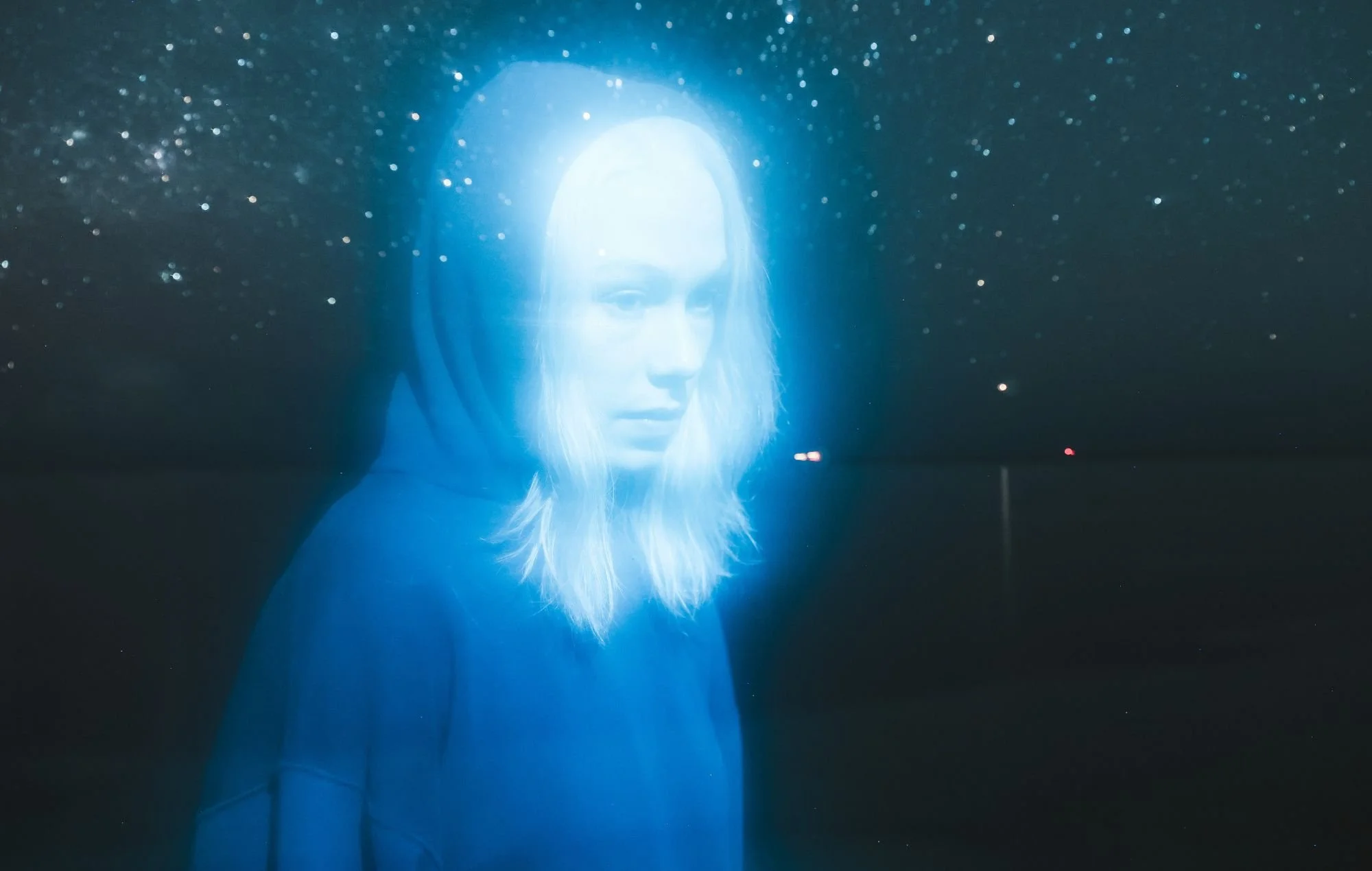
Lost Weekend is not only the title of Phoebe Bridgers’ third and most recent album, released on the 14th of August this year, but also of the 1944 novel and 1945 film adaptation The Lost Weekend, from which the record takes its name. The source material follows an alcoholic writer whose weekend is lost to a bender, while John Lennon later used the same phrase to describe his eighteen-month “lost weekend” separation from Yoko Ono. Bridgers draws on both themes of addiction and estranged love, dedicating Lost Weekend to her late father, Tony Bridgers, who died in late 2022 after a decades-long struggle with alcohol abuse. In interviews, she has described his behaviour towards her mother as “textbook domestic violence”, making the parallels between the alcoholic writer of the 1944 novel and her own father explicit. In doing so, Bridgers resists a rose-tinted elegy, instead dedicating this sixteen-track album to a grief complicated by trauma.
The autotuned, electronic opening track, ‘The Outside’, is a stark contrast to its subject matter: a funeral. Where songs of grief are typically rendered through hushed vocals and heavenly orchestral arrangements, the extensive use of a vocoder throughout this record shifts the listener away from that expectation and towards Bridgers’ dissociative state. Dissociation is a recurring theme, encountered again in ‘I Can’t Wait’, where the literary metaphor of Jekyll and Hyde amplifies the sense of a fragmented identity. ‘The Outside’, however, also establishes the singer as being on the outside looking in, placing Bridgers on a liminal plane, almost between worlds.
‘Kill Me’, the third track on the album, introduces the image of a veil as both a Halloween costume and a porous barrier between life and death. In doing so, Bridgers blurs the two, as if death were completely soluble, melting into life rather than remaining distinct from it. Alongside the repetition of “kill me” is an indulgence in thoughts of her love life: “He kissed me hello / He tastes like a flower with chemical petals.” Flowers, a motif heavily used in the painting genre vanitas, symbolise love, youth, beauty, and each their inevitable impermanence, reflected in the final repetition of “Tamám Shud”, Persian for “it is over”.
These reflections on love, also heard in ‘Lost Boys’ and ‘Bobby’, interrupt the album’s more solemn tone. The painful realisation that life continues after the death of a loved one, and that a time comes when not every moment is occupied by grief, is one that Bridgers is acutely aware of: “Feeling indifferent, wearing black / Sometimes I want you back / But not today.” This unashamed admission that mourning does not follow a prescribed process is itself interrupted by the semi-choral passages repeated in ‘Governor’s Waltz’ and ‘Liberty Tree’, forcing us back into the church where her father’s funeral is taking place.
The eleventh track, ‘Never Going Back!’, challenges the rosy nostalgia that comes with retrospect, but ultimately gives in when Bridgers listens again to one of her father’s old voicemails. This grounds her idealistic affirmation, “I’m never going back again”, in the messy reality of grief. It sets the stage for the final track, ‘Lost Weekend (Reprise)’, which, as Bridgers explained on her Lost Signal radio broadcast, is “a return to a feeling”. The song returns melodically to the sixth track, ‘Lost Weekend’, and returns us to the conflict between moving on and holding on. Within the reprise, the incessant choral-like melody is resolved, but now carried only by a single voice – a kind of narrowing of focus after the album’s more dissociative passages. As Consequence wrote, ‘Lost Weekend (Reprise)’ is a “hard-earned catharsis” for both Bridgers and the listener. This narrative resolution makes Lost Weekend a definitive concept album, structured around an arc from the initial, in Bridgers’ words, “white-hot grief” of ‘Still Standing’ and ‘The Outside’ to a quiet reflection on what she “loved about [her father] and learned from him”.
Through Lost Weekend, Bridgers offers the world a raw and unapologetic glimpse into an unspoken experience that affects us all. Albums such as Mount Eerie’s A Crow Looked at Me offer a similar exploration of grief. However, Lost Weekend is unparalleled in its emotive, almost ambient soundscape and the lyrics that inhabit it, which extend a hand to the listener and give a voice to what is usually left unsaid.