
How a Christian Socialist Indie Band Accidentally Created Fatboy Slim
By Hattie Lindohf
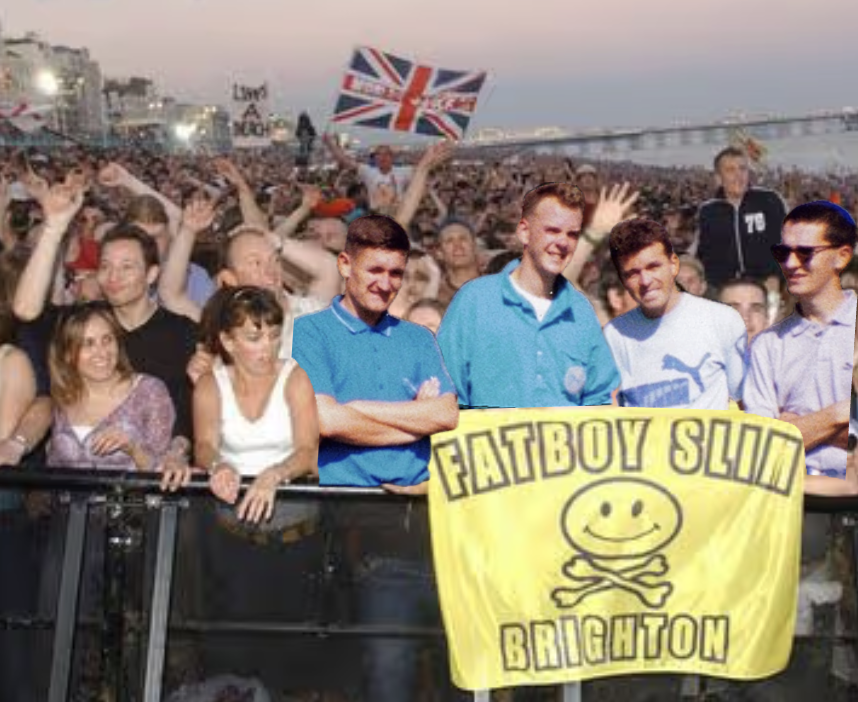
Fatboy Slim is celebrating 30 years of his debut album Better Living Through Chemistry. However, before the chemistry, there was Christianity. Norman Cook’s 1996 debut is getting an anniversary reissue, complete with remixes, rarities, and a chance to revisit the record that introduced Norman Cook’s best-known alias. Cook describes it as “basically me figuring out what I was doing”.
He had already done quite a lot, as a decade earlier, he was playing bass in the Housemartins, a Hull indie band whose debut album carried the instruction: “Take Jesus - Take Marx - Take Hope.” It is not the obvious starting point for the man behind ‘The Rockafeller Skank’, but Fatboy Slim did not arrive fully formed behind a pair of booths and decks. Getting there involved a band breaking up, several changes of name, and some uncertainty about whether Cook would have a music career at all.
The Housemartins were an unusual proposition: cheerful guitar pop with politics that were considerably less cheerful about the state of Britain. Their songs were catchy enough to enter the charts, but Paul Heaton’s lyrics had little patience for class inequality, complacency, or the people benefiting from either. The Christianity was also not just decorative. When speaking to the Galway Advertiser years later, Heaton, the lead singer, explained that he had believed in “the left wing part of the Church.” His faith had weakened, but his Marxism had not, explaining why the album-cover slogan made sense to him as a combination of belief, politics, and hope. Cook, on the other hand, had some rather less austere ambitions. “I wanted a leather jump suit with my name sequined on the back,” he told The Independent in 1999. Heaton was firmly against that sort of thing. Cook recalled taking the tube home after his first appearance on Top of the Pops, with the band determined not to succumb to the usual pop-star excesses.
This did not prevent success, however, as ‘Happy Hour’ and their a cappella version of ‘Caravan of Love’ made the Housemartins familiar far beyond the indie audience. Cook had joined a band capable of reaching people without softening its convictions. However, it was the same band whose musical direction would eventually stop satisfying him. When the Housemartins split in 1988, he was both relieved and frightened. “I didn’t want to be doing that kind of music any more,” he said. Then came the less liberating thought: “I thought I’d have to go and get a proper job.”
The obvious temptation here is to treat the breakup as Fatboy Slim’s origin story: guitars disappear, turntables arrive, everybody dances. Cook’s musical life was messier than that. He had been DJing since he was 15, long before joining the Housemartins. Dance music was not a sudden discovery made after the band collapsed, instead it was an existing interest that he now had more room to pursue.
His next project, Beats International, produced the number-one hit ‘Dub Be Good to Me’. Further ventures included Freak Power and Pizzaman before he settled on Fatboy Slim. The names changed, but the process was continuous: trying different ways to turn his record collection, production skills, and appetite for a hook into something of his own. Cook’s freedom from the Housemartins did not immediately make him happy, he later described becoming an “arrogant workaholic” after Beats International’s success. Now that he was away from the band’s restraint, he struggled with fame and his own expectations. Cook’s reinvention was not a tidy montage of increasingly successful projects, most of it was difficult and a journey of personal self-discovery.
By Better Living Through Chemistry, however, those experiments had found a convincing home. Its breakbeats, samples, and oversized hooks belonged to the developing big beat scene, but Cook’s instincts remained those of a pop musician. The tracks needed to work on a dancefloor; they also needed something people would remember afterwards. That is where the distance between the Housemartins and Fatboy Slim begins to shrink. The politics were no longer spelled out on the sleeve, and the equipment had changed, but Cook still understood the value of a song that could reach beyond its immediate audience. A bass player in a successful pop band had not forgotten what made people listen. The contrast is nevertheless part of the appeal. There is something wonderfully unlikely about the journey from an indie band invoking Jesus and Marx to a DJ whose music became shorthand for enormous parties and who became a pioneer of the big beat movement. Yet presenting it as a complete rejection of his past misses the experience he carried with him.
The Housemartins did not deliberately create Fatboy Slim, and their breakup did not guarantee him a second career, either. It removed one version of his future and left him to work out another, which leads us to thirty years on. Cook’s description of his debut still feels more useful than a grand reinvention story: he was figuring out what he was doing. The end of the Housemartins gave him the time and space to do it. Fatboy Slim was not what anyone had ordered. That was rather the point.