
Genre-Wise: The Berlin School
The pioneering synthesiser devotees
By Jakub Brzozowski
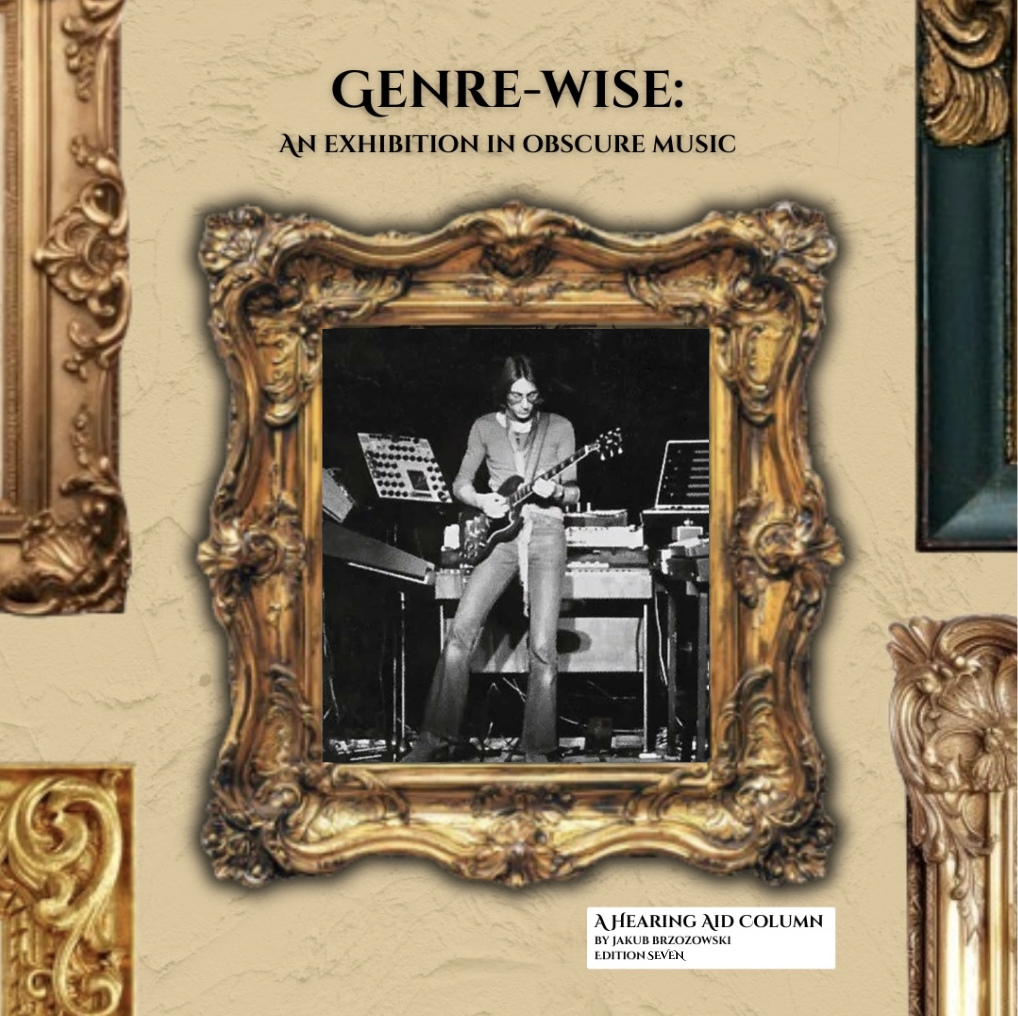
Hello dear readers and welcome to my column! I am your columnist, guide, and the custodian of (almost) forgotten music. This column is a trip to the museum of sounds that have somewhat obscured over the years, due to their niche and inaccessible nature. No worries, however, since your curator is here to shed some light on the darker corners of the annals of music. The agenda is simple: one trip (column article) = one subgenre that has vanished from the collective memory of music aficionados. Berlin School, otherwise known as Kosmische Musik (German: Cosmic Music), is a subset of krautrock bands, which eschewed the rock aspect of the genre altogether. Instead, acts like Tangerine Dream, Ash Ra Tempel (later: Ashra), or Klaus Schulze opted for cutting-edge, synthesiser-based music which directly laid the groundwork for subsequent developments in electronic music.
This column, like the previous Genre-Wise piece on Düsseldorf School, tackles a distinct subset of krautrock. However, due to shared socio-political context I won’t reiterate the rather similar background that these artists shared, as it was already discussed in a previous Genre-Wise piece. Therefore, I recommend familiarising yourself with the Düsseldorf School piece at least partially before reading this article, so that you can completely understand the impact of the Berlin School (and krautrock more broadly).
—
The story of the Berlin School unsurprisingly begins in the capital of Germany, where the Zodiac Club functioned in the late 1960s. That’s where musicians who would go on to shape the emerging krautrock scene socialised and exchanged ideas about electronic music. Among the groups active in that environment was Agitation Free who, despite their later stylistic divergence, played a key role in this formative phase. Through their connection with Konrad Latte, headmaster of the Public Higher School of Music (German: Volksmusikhochschule), they established contact with the Swiss composer: Thomas Kessler.
Sharing an interest in the contemporary forms of electronic music Latte, Kessler, and Christopher Franke (Agitation Free’s drummer) all founded a recording studio, fittingly named Electronic Beat Studio. By design, the studio was meant to create conditions of possibility for like-minded musicians to rehearse and exchange ideas about synthesisers and sequencers, while engaging with electronic techniques associated with Thomas Kessler’s approach. Apart from Agitation Free, two other bands, which ended up being pioneers of Berlin School, used the studio as their creative space: Tangerine Dream and Ash Ra Tempel. Naturally, personnel often overlapped between these groups, the key figures being: Edgar Froese, Conrad Schnitzler, Klaus Schulze, and Manuel Göttschning.
One of the first substantial products of that milieu was Tangerine Dream’s debut album – Electronic Meditation (1970). This record combines the experimental approach of Silver Apples and pioneering avant-garde composers like Karlheinz Stockhausen with late 1960s psychedelic rock. The record itself contains Froese on guitars, keyboards, Schulze on percussion, and Schnitzler on cello, violin, and various sound effects.
More specifically, the unique factor of Electronic Meditation is its soundscape-like nature, clashing with the more rock-oriented ideas of Froese and Schulze’s pounding percussion. The music seems to be ceaselessly meandering and constantly shapeshifting. This can be largely credited to Conrad Schnitzler who loftily claimed that: “They (the rest of the band) tried to make nice music I just interfered with. 'You destroyer, you!' Klaus Schulze always shouted.”
The band itself was formed by Froese in 1967, who under the heavy influence of surrealism, decided to name his new project Tangerine Dream. In line with the name – the music was also meant to be eccentric and, indeed, it included custom-built instruments and random sounds amassed on tape loops, which would eventually culminate in their trademark sequencers. This vision, along with Schnitzler’s deconstructivism, was captured in the above-mentioned Electric Meditation.
It was only their second album, however, which would present what the band is nowadays most known for. With Schnitzler’s departure, and the shift behind the drumkit (Schulze left, Franke stepped in) the project became a more personal endeavour for Froese, who now, owing to his psychedelic roots, focused on evoking the feelings of space in music. Alpha Centauri, released in 1971, is the record that prompted the term “Kosmische Musik” as an attempt to label the music it contained. Here the cosmic spheres seemed to have settled as the sounds are much more meditative and not dissimilar to modern ambient music’s standards.
Their next album Zeit (1972) fully fleshes out the concept hinted at Alpha Centauri with 75 minutes of drone-ambient unintentionally reflecting Lovecraft’s cosmic indifference. Much like its cover art, their third album is like a sonic black hole. This record is the first time when the band fully adopted the compositional logic of ambient music – it could be used purely functionally as “something in the background”, yet simultaneously an attentive listener will find a wealth of textures to be immersed in. Zeit is also the only album in their vast catalogue that doesn’t seem to bear the somewhat turgid influence of progressive rock and hence loses the genre’s theatrical burden, instead opting for playing with the atmosphere itself. A worthy candidate for the title of the first dark ambient record in history.
Their following release – Atem (1973) tempered the bleakness of Zeit while pointing towards the more codified Berlin School sound which they would later coin. The record that would come to define their canonical sound is Phaedra (1974). It marked both an artistic and commercial breakthrough for the band. Creatively, this album started their journey with sequencers and Moog synthesisers, which would become synonymous with the band. Commercially, the album reached number 15 on UK album charts remaining there for 15 weeks. This was notable given that the British music press often treated ‘krautrock’ rather dismissively – that genre tag itself was meant to diminish. The reason for their sudden popularity is the absence of friction and abrasion, that characterised much of the band’s earlier output. The music, now smoother and more atmospheric, presenting itself as a more accessible exploration of synthesisers.
Phaedra and its successor, Rubycon (1975), can be understood as two sides of the same coin, since the latter extends the trajectory established by the former. As the record is named after the famous river associated with Caesar, its themes shift from Tangerine Dream’s usual extraterrestrial imagery to a more aquatic one, as arpeggiated synthesisers evoke ebbing, flowing, and submerged motion. Tangerine Dream crossed a creative Rubicon with this album marking what can be seen as the end of their genuinely exploratory phase.
This is not to suggest that the next album, Stratosfear (1976), or much of their subsequent output aren’t worthwhile. Nonetheless, they sound largely derivative of Phaedra and Rubycon. Tangerine Dream are often described as progressive electronic, and rightfully so; however, their music seems to be lacking any substantive progression since the mid-1970s. Moreover, while Phaedra and Rubycon retained an almost otherworldly quality, following Stratosfear the band once again embraced the influence of prog rock, and with it came excessive arrangements and pompous narratives around their work. However, some of their later material is still artistically valuable, namely: Force Majeure (1979) and Thief (1981) – the soundtrack to Michael Mann’s highly influential neo-noir of the same title.
Another influential act in the development of Berlin School’s sound is Ash Ra Tempel. The band started out as a trio of the earlier introduced Klaus Schulze (drums, synthesisers, vocals), Manuel Göttschning (guitar, synthesisers, vocals), and Hartmut Enke (bass, synthesisers, guitars). The group formed after Schulze left Tangerine Dream, and this is traceable, as the band was cross-pollinated with the collective jam-like logic of Electronic Beat Studio and the Zodiac club.
Their debut Ash Ra Tempel (1971) is effectively a more coherent exploration of that aesthetic, than Tangerine Dream’s debut. Coherent, doesn’t mean domesticised though, since the record, consisting of two 20-minute long pieces, is closer to a shamanic psychedelic ritual, than conventional, mild space rock excursion. This is particularly palpable at various points of the first track ‘Amboss’ where Schulze’s pounding drums locking into a mantric, though increasingly out-of-control, groove while coinciding with Göttschning’s soaring, abrasive guitar leads.
After that album Schulze left to pursue a solo career (more on that below) and their second album Schwingungen (1972), and all the rest under Ash Ra Tempel moniker, were recorded with differing drummers. Not only was the rhythmic intensity lost with Schulze, but also a certain otherworldliness, because now the music became far more conventional, including more vocals and eschewing the trance-inducing nature of their debut record. Still, sonically, the album is quite exploratory, which can’t be credited to its three successors all released in 1973: Seven Up, Join Inn, and Starring Rosi. While these albums have their differentiable qualities like the inclusion of the psychologist Timothy Leary on Seven Up; or the guest appearance of the singer Rosi Müller, on Starring Rosi, they all tend toward more diffuse, multi-authored psychedelic forms characteristic of the period.
In 1975 after the dissolution of Ash Ra Tempel as a collective unit, Göttschning released his solo debut Inventions for Electric Guitar, crediting it as “Ash Ra Tempel: VI.” This record sees him exploring minimalism, taking influence from composers like Terry Riley or La Monte Young, but deciding to focus solely on prepared guitar. The album consists of 45 minutes of sustained arpeggiated guitar along with ambient lead parts completing the album’s volatile atmosphere. In some sense the album can be read as an exploration of the possibilities of guitar’s timbre.
The following album: New Age of Earth (1976/77) is a synthesis of that minimalistic guitar-based approach with synthesiser-driven soundscapes, akin to Tangerine Dream. Nonetheless, Göttschning’s music has its unique quality of being far more minimal and subtly deconstructive at times, as showcased by the sudden textural saturation resulting in the abrasive finale of the closing track ‘Nightdust’. The reason for the dual album release date is that Göttschning initially released the album under his own name, however in 1977 upon signing a contract with Virgin, he decided to adopt a new pseudonym: Ashra.
The following record – Blackouts (1978) expanded on that formula while still being effectively Manuel Göttschning solo release. The record sees Göttschning comfortably interlocking his characteristically sparse guitar leads with sequencer-based soundscapes. The following year, however, he decided to expand the lineup, and so an ensemble of himself, Lutz Ulbrich on keyboards, and Harald Grosskopf on drums recorded the third Ashra record: Correlations (1979). This along with the subsequent Ashra records developed the trajectories established by New Age of Earth and Blackouts, making the music more rhythmic, structured, and open to external influences (e.g. funk elements of 1980’s Belle Alliance).
Finally, Manuel Göttschning also released E2-E4 in 1984, a record that anticipated forms later adopted by minimal techno artists. The album is an hour-long track of structured electronic improvisation recorded by Göttschning in 1981, that adopts only a handful of motifs which are then reused numerous times during the album’s runtime. This makes the album unique and distinct from later house music, which while indeed similar in form, doesn’t place emphasis on the trance-inducing nature of the music, which Göttschning retained from his early years.
Concurrently to Göttschning’s creative undertakings, his former bandmate – Klaus Schulze also pursued his own solo career. He released his debut album – Irrlicht in 1972, which was parallel in form to Tangerine Dream’s Zeit coincidentally released the same year. The album itself is atmospheric and moody, containing washed out organ drones and orchestral recordings processed beyond recognition.
He continued in that atmospheric direction with 1973’s Cyborg where he gained access to primitive synthesisers so the album is more futuristic in sound, though loses some of its predecessor’s atmospheric austerity. The next record, Blackdance (1974), is where “For the first time KS uses ‘real’ synthesisers and a singer.” The following record: Picture Music (1975) is his only solo recording featuring his characteristic drumming.
The next two albums in his catalogue are often considered the apogee of his creative prowess: Timewind (1975) and Moondawn (1976) are far more in line with what Berlin School sound is associated with, rather than the idiosyncratic nature of his earlier recordings. The former introduced the characteristic arpeggiated patterns – nowadays synonymous with Schulze’s work, while the latter can contend for the best drum performance in the genre, laid down by Ashra’s Harald Grosskopf. Furthermore, Timewind directly referred to Richard Wagner as one of the tracks was entitled ‘Bayreuth Return.’
The following album Mirage (1977) was a detour into more “cold and icy textures,” which were inspired by Schulze’s dismal mood at the time – following the death of his brother to whom the record was dedicated. The succeeding record “X” was explicitly a concept album, where his Wagnerian ambitions reached zenith, as the six pieces which comprise the record are musical biographies of figures from the German-speaking world Schulze greatly admired.
Beyond its principal architects, Berlin School was sustained by a range of solo artists who expanded its vocabulary in distinct directions rather than merely reiterating a common formula. Harald Grosskopf pushed its sequencer logic towards greater rhythmic propulsion, while Michael Hoenig preserved a more expansive and cinematic interpretation of Berlin School’s sound. Peter Baumann cultivated a more melodic and atmospheric sensibility, whereas Adelbert von Deyen pursued a colder and more austere synthesiser mysticism. Wolfgang Riechmann and Peter Michael Hamel each, in different ways, drew the music towards increasingly contemplative and lyrical terrain, while Baffo Banfi carried aspects of the idiom into a directly progressive and Mediterranean register. Even later figures such as Bernd Kistenmacher are noteworthy less as revivalists than as evidence that Berlin School was never a closed canon, but a flexible compositional logic capable of mutation beyond its classic 1970s phase.
Early-to-mid 1970s Berlin School recordings helped establish several compositional approaches later developed independently in ambient music by artists such as Brian Eno, Hiroshi Yoshimura, and others. The otherworldly aspect of the music influenced artists like Steve Roach, or Michael Stearns contributing to what would later be termed space ambient. The desolate and empty atmosphere of Tangerine Dream’s Zeit (1972) likely inspired artists like Lustmord to merge ambient’s compositional nature with industrial starkness, a subgenre post-hoc recognised as dark ambient. Manuel Göttschning – Ash Ra Tempel’s co-founder was highly influential as a solo artist, particularly through his minimalistic prepared guitar work on Inventions for Electric Guitar (1975) and with E2-E4 (1984), a record identified as a key precursor to later minimal techno and house music. Finally, the escapist and instrumental nature of Tangerine Dream and Klaus Schulze’s mid-1970s output, alongside later neoclassical darkwave influences such as Dead Can Dance, aesthetically informed black metal artists in the 1990s. Their Middle Earth-inspired electronic excursions, often working as instrumental introductions to actual albums, were retroactively categorised as dungeon synth.
The term “neo-Kosmische” has been used to describe various revivalist or stylistically adjacent projects, though it remains loosely defined rather than a coherent genre.
Playlist for the article: https://open.spotify.com/playlist/38bhkwY22PcVUF4LKGq9ks?si=7c26bdd9f41d4dbb