
Genre-Wise: Zeuhl
By: Jakub Brzozowski
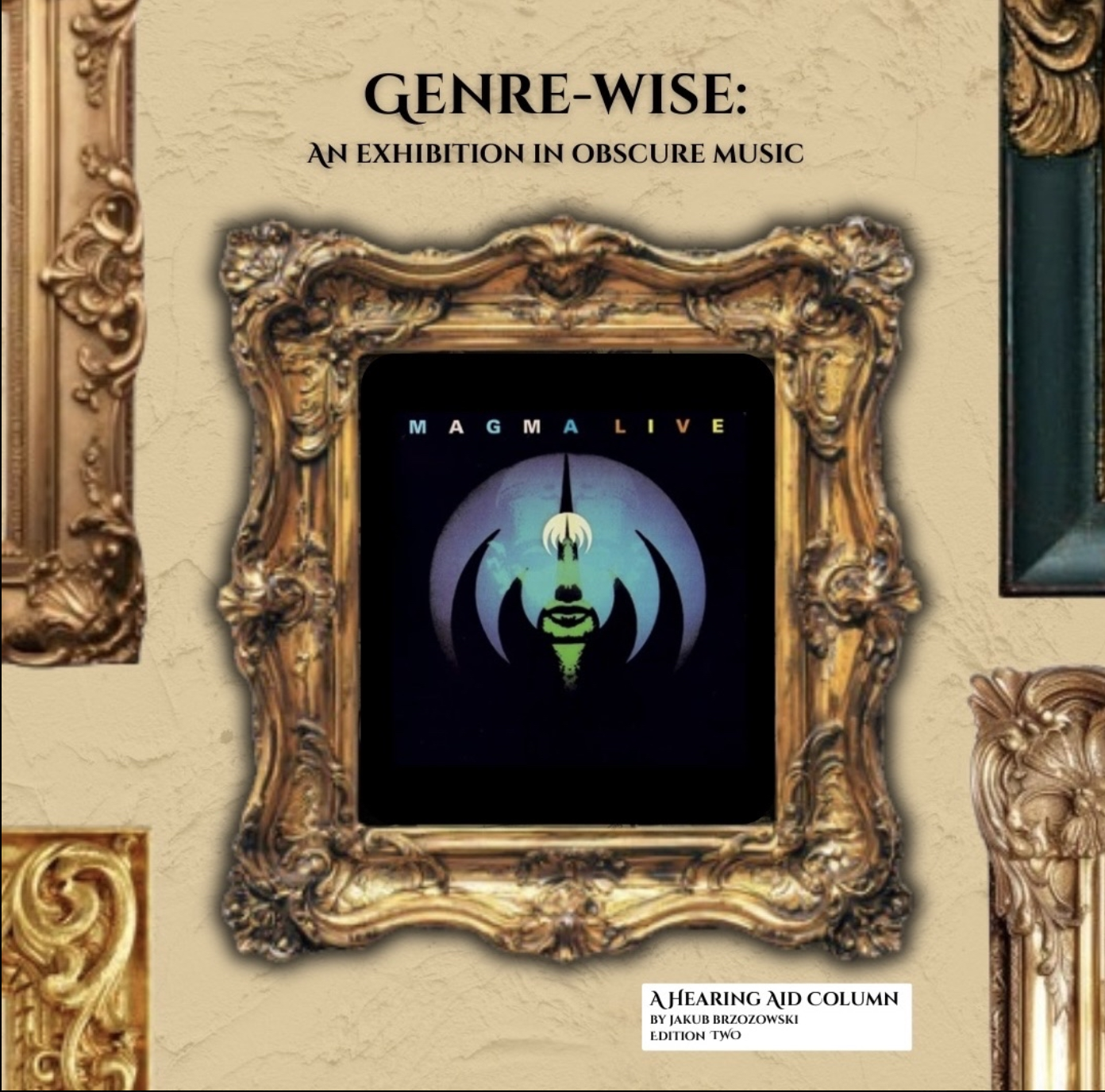
Hello dear readers and welcome to my column! I am your columnist, guide and the custodian of (almost) forgotten music. This column is a trip to the museum of sounds that have somewhat obscured over the years, due to their niche and inaccessible nature. No worries, however, since your curator is here to shed some light on the darker corners of the annals of music. The agenda is simple: one trip (column article) = one subgenre, that has vanished from the collective memory of music nerds. This time, we will be exploring the work of my favourite musical aliens – the French band Magma and all of their epigones, the music style they cultivated collectively is known as zeuhl.
The genre name zeuhl was initially attached JUST to one band’s music — the above mentioned Magma. The group’s approach to music was so singular that journalists made up a genre tag to classify them. Later on, other bands started adopting their style, and so the genre was attached to other bands, mainly from France and Japan. Nevertheless, the only criterion that made a band zeuhl is that they were influenced by Magma..
Before we dive deeper into the story itself, the meaning and etymology of the name “zeuhl” requires explanation. The word “zeuhl” is from a fictional language called Kobaïan, created by Magma’s founder, main composer, (band)leader, and drummer, Christian Vander, in which it means “celestial.” A mixture of Slavic, German, and Leon Thomas-inspired scant yodeling, Kobaïan was created solely for writing the band’s lyrics. All of the band’s releases are concept albums taking place on the fictional planet – Kobaïa. The language rendered Magma alien, sci-fi, and otherworldly.
Speaking of the band’s personnel, I did not try counting all of the performers who appeared on at least one of the band’s releases, but rough estimates include figures from 80 to 130. Most of those musicians are credited on just a few albums, which is why I won’t be highlighting them further on, instead referring to Magma as a collective of musicians led by the group’s mastermind Christian Vander.
Now, let’s get back to the very beginning. Magma (or rather Univeria Zekt Magma Composedra Arguezdra) started in the summer of 1969. The band started in an attempt to fill the void that was left by the late John Coltrane, who had tragically died just two years before that at the age of 40. He has been the main inspiration for Magma’s frontman, and zeuhl in general certainly owes a great deal to Coltrane’s experiments. Another key inspiration for the band’s music was the modernist composer Carl Orff. Importantly, Vander took inspirations from the latter “spiritual” part of Coltrane’s body of work, which strayed away from classical jazz sensibilities, in favour of free improvisation and less confined song structures. You can hear Coltrane’s influence permeating through Magma’s albums, particularly his 1967 Kulu Sé Mama (incidentally, my favourite Coltrane record), with its elevated, but simultaneously chaotic and tribal atmosphere. In a way Magma are conjuring a similar, celestial, atmosphere. That, coupled with the modernist classical influences of aforementioned Orff (Stravinsky, Bartok, and others are equally arguable), which ground the music structurally, give it a more operatic flavour.
It’s almost as if there are two main currents which are simultaneously battling and reinforcing each other in Magma’s music. One of those is the free jazz, which informs Vander’s hectic drumming, polyrhythmic chaos, uncanny progressions and harmonies. It shapes the way the instruments are played (e.g. walking basslines), the instrumentation itself (inclusion of brass instruments, and piano played in a distinct jazzy manner) and the overall complexity of the music. This coupled with the fact that Magma operates within the rock idiom earned them the jazz rock label. Conversely, there is an operatic, classical current in their music. The bloated vocal harmonies are drawn from the aforementioned composers, and stand in clear contrast to the jazz tradition, which the group also exhibits. What they enforce is a sense of rigidity amidst the chaos. Listening to Magma, one can feel like you’re witnessing an incomprehensible horror space opera, which seems chaotic and overwritten, but deep down you know that the writers know precisely what they’re doing. The rhythmic nature of the vocals is quite unusual for its era and style of music, as prog rock seemed to be much more focused on mastering the melody, rather than the rhythm. This is why, the badge zeuhl is righteously attributed, as their combination of influences is contradictory and until their disciples started emerging, there was no band like them.
But back to the ensemble’s history now. After finding eight like-minded musicians to realise his vision, Vander proceeded to record Magma’s self-titled debut album, nowadays known as Kobaïa (the planet on which Magma’s lore is crafted). It was released by Philips records, which is noteworthy for such an unconventional band. This album establishes the lore of Kobaïa: Earth is doomed, so a group of people decide to flee for the delightful planet we mortals know as Kobaïa. This is where Magma’s the closest musically to the Canterbury Scene (Soft Machine particularly) and their other influences generally. After their initial tour, the group experienced a few personnel changes and immediately proceeded to record their second album: 1001° Centigrades, otherwise known as 2. The album finds the group more focused than on their debut – there are only three monolithic songs and the music is closer to what is associated with zeuhl, without detours into more jammy fusion aspects of the debut (at least on the first song). As for the history in lyrics, the album develops the story from the self-titled record, but this time Kobaïans return to Earth to save it from its imminent doom. Around this time the band was touring and was featured in the Montreux Jazz Festival’s lineup in 1972, which gave them more exposure.
1972 was a year of atomisation for Magma - they split their efforts in two. On one hand Christian Vander created the soundtrack to Yvan Lagrange’s interpretation of the medieval story of Tristan and Isolde (Tristan et Iseult, 1972). The score features the usual operatic style of zeuhl, but in this case it is more tame, due to constraints of the form. Conversely, Magma (under the alias Univera Zekt) released a record entitled The Unnamables. This is far closer to conventional jazz rock sounds, while preserving some of their ingenious zeuhl style, but omitting the Kobaïan mythology. It was recorded in an attempt to convince a broader audience to listen to Magma’s music, unfortunately with limited success.
After that partitioning of their creative prowess, however, Magma managed to touch the divine celestial (!) spark that they were seeking since their formation. Mekanïk Destruktïẁ Kommandöh released in 1973 is considered to be their seminal album. This is the blueprint zeuhl record. While being excessive, as all of Magma’s music is, this album feels concentrated, in a way minimalistic and even martial. It’s mostly driven by piano along with the incessantly pulsating rhythm section. While no influence was acknowledged, it certainly aligns with John Cage and Steve Reich’s experiments with repetitive structures. The songs are more compact and punchy, they are also the most distinctive ones in the whole Magma’s catalogue. For example, ‘Hortz Fur Dëhn Štekëhn Ẁešt’ and ‘Mëkanïk Kömmandöh’ are crafted with incredible confidence, every note seems to be indented and placed with surgical precision. It’s not surprising, however, when taking into account that developing this album took two years. Even the enduring visual identification of the band has been established on this album, with the glyph on the cover art definitely becoming “Magma’s emblem.” Mekanïk Destruktïẁ Kommandöh was also the group’s most critically successful album – The Rolling Stone named it the 33rd best French Rock album, as well as the 24th best Prog Rock album, which for music that “out-there” is a serious marker of acclaim.
Riding on that wave of relative popularity, Magma entered its busiest period: in 1974 they recorded Köhntarkösz, an album that continued the musical threads from Mekanïk, but this time the discipline and focus were not on that astronomical level. Concurrently, though, they managed to get a slot at the famed Newport Jazz Festival, which also marked their first performance in America. That year, Vander also released his Tristan et Iseult score as a solo album. 1976 was yet another release year for Magma, this time with the quirkily titled: Üdü Ẁüdü. This record already shows that the formula found on their third full-length album was somewhat wearing out. The music on Üdü Ẁüdü seems lighter and more conventionally groovy, exhibiting some distinct funk influences, which nicely merge into the jazzy fabric of Magma’s style.
Those funk influences were fully fleshed out on their next LP: Attahk (1978). The album is very much like its cover: not as serious, when compared to its predecessors. It strays away from their typical zeuhl sound and instead is a funky jazz fusion record with some elements present earlier, i.e. the choral chants. Historically, it’s obvious why Magma did that, after five years since their landmark album, they wanted to see some commercial success and were very aware of the fact that zeuhl wouldn’t convince masses to queue for their records. In a broader sense, 1977-79 marked the decline of 70s prog, which after all, Magma was sprung from. Logically then, they had to follow suit and fulfil the historic necessity of try releasing a more accessible album in the late 70s despite its mild commercial failure. Still, compared to Emerson, Lake & Palmer’s Love Beach for instance, Attahk makes for a satisfactory listen and shows you how zeuhl would sound in its more approachable form, or how fusion would sound when you sprinkle some zeuhl elements in.
After the unrealised expectations of their seventh LP, Magma was done. They released one more (farewell) album in 1985, aptly entitled Merci, whose musical analysis I will spare you and myself. After two long decades they came back with another LP K.A. in 2004 and Ëmëhntëhtt-Ré in 2009, which form a trilogy with 1974’s Köhntarkösz. While it is a a very satisfying comeback, I’d expect them to be more adventurous, rather than recreating the sound coined on their first four albums. They continued recording and touring globally, earning acclaim as a live institution. They performed in Australia, Asia (Japan!), and South America. Magma also played the well-known Roadburn Festival (2014 and 2017) in the Netherlands, and were featured in the second edition of the RIO reunion festivals.
This isn’t the end of our story just yet. In spite of Magma’s singularity they did gain a cult following, which inevitably spawned some successors. The first groups to do so were naturally from Magma’s native France. The most notable band to mention would be Dün, who released Eros, their sole LP, in 1981. This album is closer to an experimental, jammy avant-prog rock, but its ritualistic atmosphere secures it a space in the zeuhl cannon. Another one, and my personal favourite, is Shub-Niggurath. To me, the only band who managed not only to live up to the insanely high artistic level of Magma’s music, but also develop the zeuhl genre in some other direction. Their best album, Les Morts Vont Vite was released in 1986. Firstly, let’s just note how out of their era this album is, by 1986 even neo-prog was dead (except for Marillion) and generally all forms of progressive rock were yesterday’s news. Secondly, and far more importantly, this album turns the zeuhl into a true horror-like experience. Where Magma dabbled in horror, Shub-Niggurath evokes it on a cosmic level. It’s no surprise that they were inspired by the literary output of a certain recluse from Providence. Another noteworthy name in French zeuhl is a “Magma spinoff” band called Weidorje. Made up of Magma’s former members, the band’s self-titled and only album shows an alternative path for zeuhl’s creators after Üdü Ẁüdü – this record eschews the characteristic mantric vocals and focuses on zeuhl’s uneasy groove. It conjures up the psychedelic atmosphere through an unusual jam session, rather than methodically structured group assault, which Magma usually employed. Other noteworthy French zeuhl bands are: Eider Stellarie, Unit Wail, One Shot, Potemkine, Eskaton, and Zao.
Now onto the more unlikely zeuhl scene that has formed over the years. The story of Japanese zeuhl begins with Happy Family’s debut eponymous record released in 1995, with other notable genre’s cultivators from the country emerging after Happy Family’s release (notable bands include: Koenjihyakkei, Bondage Fruit, and Ruins). Japanese zeuhl groups follow up their fellow experimentalists like Merzbow, Boris, Boredoms, and Melt-Banana to name a few, and Japanese zeuhl is far weirder and definitely more intense than any other representative of the genre. Japanese bands, particularly Koenjihyakkei, inject brutal prog, making zeuhl unpredictable and frantic.
Zeuhl as singular and separate as it is has managed to permeate other forms of music. Most notably avant-prog bands have taken plenty from Magma’s ideas, a model example would be a Rock in Opposition band: Univers Zéro. Equivalentially, other avant-prog bands who also could be attributed some zeuhl characteristics would be: Corima (USA), Present (Belgium), J.A. Ceaser (Japan), Kultivator (Sweden), and Universal Totem Orchestra (Italy). As an avid metal fan I have also noted that zeuhl’s fabric has blended quite nicely within the more experimental forms of the genre. The band, which is the most adept at that would certainly be Papangu, hailing from Brazil. They wear the zeuhl influence on the sleeve and mix it with unconventional post metal, and also some brutal prog elements. Similarly, the whole “psychedelic black metal” movement with Oranssi Pazuzu as its informal leader seems to owe some elements of their style to zeuhl, particularly the work of Shub Niggurath. Finally, classics like Pan.Thy.Monium, and Ved Buenes Ende also bear some similarities to zeuhl.
Finally, to utterly convince you that Magma’s music is to be found in all sorts of places I will list a few admirers of the band, some of them – quite unlikely. First off, John Lyndon from Public Image Ltd and Sex Pistols considered himself amongst the fans of the band. Predictably, devoted prog nerds Mikael Åkerfeldt (the frontman of Opeth) and Steven Wilson (the mastermind of Porcupine Tree and a renowned solo artist in his own right) also declared their fandom. Bruce Dickinson from the heavy metal legend Iron Maiden, and Travis Ryan from the technical death metal heavyweight’s Cattle Decapitation, also praised Magma’s music. Kristoffer “Garm” Rygg – the mastermind of Norwegian unclassifiable mavericks Ulver also stated that he’s a fan. Additionally, in the documentary To Life, Death and Beyond – The Music of Magma (2017) musicians interviewed for its purposes included: King Crimson’s long-time bassist Trey Gunn, Metallica’s longest standing bassist Rob Trujillo, and hardcore’s legend and Dead Kennedys’ frontman – Jello Biafra. Even more astonishingly, I’d like to inform you that snooker champion Steve Davies funded Magma’s three concerts at London’s Barbican and claimed to be an extreme fan since the band started off. Similarly, a TV presenter Antoine de Caunes is also the author of the band’s biography.
The following is an accompanying playlist to the article. It takes the chronological approach of: influences → Magma → Other zeuhl → Music influenced by zeuhl. Happy discoveries!