
Genre-Wise: War metal
Are there any MANIACS reading this now?
By Jakub Brzozowski
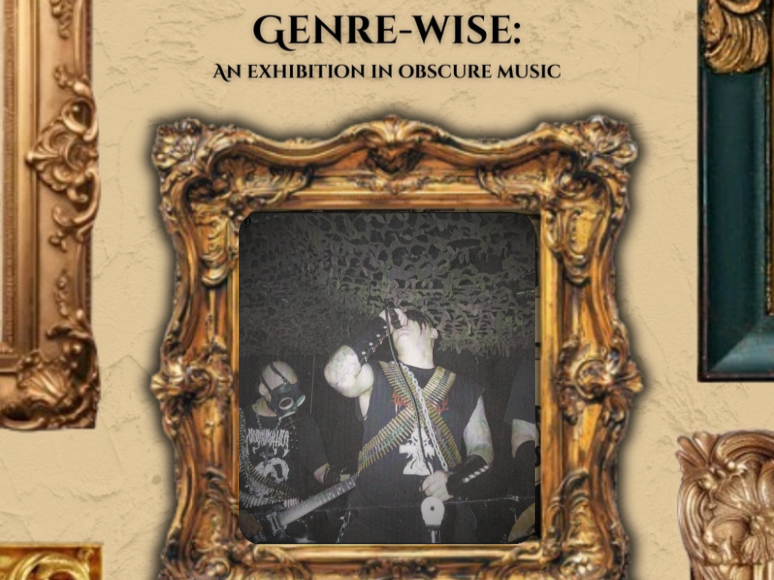
Hello dear readers and welcome to my column! I am your columnist, guide and the custodian of (almost) forgotten music. This column is a trip to the museum of sounds that have somewhat obscured over the years, due to their niche and inaccessible nature. No worries, however, since your curator is here to shed some light on the darker corners of the annals of music. The agenda is simple: one trip (column article) = one subgenre that has vanished from the collective memory of music aficionados. War metal, otherwise known as bestial black metal is a radical outgrowth of black metal, which started with 1st wave black metal bands, such as Sarcofago (and more broadly 1980s Brazilian extreme metal scene), Blasphemy, Beherit, Bestial Warlust, and Archgoat. Musically, the genre is a combination of black metal’s rawness, death metal’s riff-centric heaviness, grindcore’s chaotic nature, and occasionally more thrash metal-like drive. The scene started in late 1980s, but only flourished in the 2000s, due to retromania and nostalgia for metal’s supposed more radical past, and the unprecedented (relative) success of Revenge and other bands from that Canadian circle (Conqueror, Black Witchery).
–––
Since the emergence of Black Sabbath, metal has always strived for extremity. Each successive mutation increased intensity: the speed and blasphemy of Venom, the aggression of Bay Area thrash, and the bruising brutality of early death metal acts such as Death, Possessed, and Master. That lineage would eventually culminate in war metal.
War metal’s roots can be traced to the blasphemous speed metal hybrid from Newcastle – Venom. Their work inaugurated a subgenre of metal retroactively considered as the first wave of black metal. The originators themselves used satanic imagery to trigger outrage and distinguish themselves from their influences. The fact that the adopted aesthetic wasn’t completely sincere was already obvious on their sophomore LP – Black Metal (1982) which lent its name to the genre, and contained the regrettable song ‘Teacher’s Pet’. Nonetheless, Venom’s musical simplicity and directness influenced all the other 1st wave black metal bands.
Bands influenced by Venom appeared almost immediately, particularly in Germany. Early recordings by the Teutonic thrash metal bands Kreator, Destruction, and Sodom combined thrash metal with Venom’s rawness and iconoclastic atmosphere. Alongside the early works of Slayer, these recordings represent what is now commonly recognised as black thrash.
Another tiny hotspot for groundbreaking metal extremity appeared in Switzerland with the short-lived group: Hellhammer. Formed in 1982 by Tom Warrior (Thomas Gabriel Fischer) and Steve Warrior (Urs Sprenger), they altered the metal scene completely with just three demos, after which they dissolved in 1984. Hellhammer’s music combined Venom’s slower riffs and blasphemous lyricism, with the D-Beat originators – Discharge’s speed resulting in something closer to a horde of barbarians, rather than three musicians playing in a room together. They, along with Mercyful Fate, are the pioneers of the use of corpse paint, which became a crucial element of war metal’s aesthetic. Hellhammer was followed up by the formation of Celtic Frost – Tom Warrior’s life’s work.
Another band significant to the development of extremity in the 1980s is Bathory, a one-man project masterminded by Quorthon (Thomas Forsberg). Similarly to Hellhammer, Bathory’s debut is also a concoction brewed out of Venom, Discharge, Motörhead, and G.B.H. More importantly, Bathory’s second album,The Return (1985), was a landmark statement of musical extremity, which was highly influential for war metal. The record’s mix sounds closer to a cave, rather than a conventional studio. Moreover, the unstoppable pace of the standout opener: ‘Total Destruction’ directly influenced war metal’s incessant rhythmic cannonade. The album’s successor, 1987’s Under the Sign of the Black Mark was equally influential to the whole nascent black metal scene, but this time the focus was placed on atmosphere and slower, more monolithic tracks.
The next manifestation of extremity was the early Brazilian extreme metal scene. One of the scene’s key participants, Sarcófago, is oftentimes credited to be a direct progenitor of war metal. In particular, I.N.R.I (1987), their debut contains a mixture of influences and stylistic hallmarks, which later would compound into war metal. Musically, it’s an amalgamation of first wave black metal, the depths of thrash metal, the still-forming death metal, as well as grindcore. Importantly, the elements of grindcore are a differentiating factor for the band, allowing them to introduce an unmeasurable dose of chaos within the music, something war metal thrives upon. Grindcore also provided war metal with its most prevalent drum beat, that being blast beat. It consists of synchronised eight notes on the snare drum and the crash cymbal in tempos exceeding 200 BPM. I.N.R.I’s hectic nature can equally be ascribed to the musicians’ attempts to outperform their skill levels. The record also pioneered the barked vocals that are characteristic of war metal. This album simply feels out of control and resembles a raging Elden Ring boss rather than a calculating villain like AM.
Alongside Sarcófago, the Brazilian metal scene was a wider hub for proto-war-metal extremity. Chakal, Holocausto, Mutilator, and Sarcófago can all be found on the 1986 compilation, Warfare Noise, which is a great gateway into those unrelenting sounds. Holocausto is particularly notable, as the earliest appearance of the genre-tag “war metal” was on the back side of their debut: Campo de extermínio (1987). The band’s name and their debut’s subject matter often led to them being mistakenly presumed Nazis. However, the title track contains lyrics like “Nazistas sádicos” (“Sadistic Nazis”), or “Ditadores loucos” (“Mad dictators”), which showcase that the band doesn’t endorse World War II atrocities, but rather utilises controversial imagery similarly to Jeff Hanemann’s lyrics to Slayer’s ‘Angel of Death’. In addition the first two albums by Sepultura are also fine specimens of this early Brazilian scene.
All of these bands were but a mere entrée when compared with the defining war metal band: suggestively named, Vancouver’s Blasphemy. The band was formed in 1984 by Gerry Bull (vocals, bass) and Sean Stone (drums), known respectively by their long-winded stage names 'Nocturnal Grave Desecrator and Black Winds' and '3 Black Hearts of Damnation and Impurity'. Shortly, they were joined by the guitarist Geoff Drakes aka Caller of the Storms. Metal music does have a tendency for exaggerated nomenclature, but Blasphemy pushed it a degree farther and thus introduced the multi-clause names that came to be a quintessential part of the war metal aesthetic.
After five formative years the band recorded their first demo tape in 1989 entitled, Blood Upon the Altar. Blasphemy’s first release defined what war metal would be musically. Contrary to Sarcófago, Blasphemy is not merely a sum of its influences, but a complete vision, presenting an intensity not yet seen in extreme music. The production is noisy and punishing, the riffs are either virulently fast, or crushingly heavy, the drums function as an agent of chaos rather than a stabilising anchor, the bass is aptly chunky, and the characteristic whispering vocals credibly portray an otherworldly entity. The record’s cover art also established the uniform black-red-white aesthetic so essential for war metal.
Just a year later Blasphemy released what many call their defining statement their first, and only fully-fledged, album: Fallen Angel of Doom (1990). True to war metal’s nature, the album is an aesthetic regression. Musically it represents the same high-octane black/death metal mixture that appears on their demo. The production, however, is truly the standout feature here – the record sounds, as if recorded in a cavern. It seems like their album should be their demo, and their demo their album. Nonetheless, the album is a benchmark for intensity in extreme metal, particularly in war metal.
In 1993 Blasphemy released their second and final album – Gods of War. Its A-Side mostly consists of re-recordings of older compositions, while B-Side simply contains Blood Upon the Altar as “bonus”. Needless to say, it’s quite an underwhelming way to end such a spectacular discography. Disappointingly, in spite of their continuous live shows, Blasphemy has not released any studio material in more than 30 years.
Blasphemy is also responsible for the conspicuous stage image employed by war metal bands. An assortment of bullet belts, studded bracers, gas masks, the characteristic corpse paint, and sunglasses are all distinct features of the war metal aesthetic thanks to Blasphemy. The group’s own slogan, “Black Metal Skinheads”, owing to all the band members sporting shaved-heads, in direct contrast to long-haired aesthetics of the metal scene. They also assert that this term is not racist in nature and purely refers to their hairstyle. That’s fairly believable as Caller of the Storms, who joined them in 1984 is an African-American. The catchphrase, itself, was apparently coined when the band members saw an actual skinhead with a sizeable tattoo saying “BLACK METAL”.
This article would be dishonest if it omitted real-life extremity of Blasphemy. The list of their offences includes narcotics distribution, people smuggling, and assaulting a police officer. Apparently, most of the band members spent some time incarcerated, which can explain their disappearance post 1993 ,up to 2009, when they restarted their live activity. The band is also notoriously banned from performing in the U.S, but a concrete reason is difficult to establish. These allegations might also explain why sketchy personalities are drawn to war metal and Blasphemy in particular. Though I can’t say I endorse the criminal behaviour of the band and much of their fan-base, their personalities and music are still vital to the music and aesthetic formation of the genre.
Two other pioneering early war metal bands hail from Finland. Beherit and Archgoat were both stylistically similar to Blasphemy in the early stages of their careers. Beherit was formed in 1989 by Marko Laiho, better known as Nuclear Holocausto Vengeance. Nonetheless, Beherit’s music never was political and that nickname was in all likelihood employed for controversy and not affiliation. Their defining war metal contribution is their 1991 album, The Oath of Black Blood, which contains a more primitive variant of the Blasphemy-style assault. Archgoat’s first demo Angelcunt (Tales of Desecration) (1993) also includes this Blasphemy-like charge. Their unique style, however, of contrasting monotonous blast-beat driven surges with slower and groovier parts was only crystalised after a decade-long break following their first two LPs. Two other noteworthy early war metal bands from Australia are Sadistik Exekution and Bestial Warlust.
Conqueror is the first post-Blasphemy war metal band to mark the war metal territory as their own. The Vancouver duo of Ryan Förster and James Read released a genre-defining statement with War.Cult.Supremacy (1999), which ended up being their single release. That record plays less like a direct Blasphemy worship but rather a frenetic mutation of Sarcófago and Bathory’s Under the Sign of the Black Mark. In other words, the record takes the most abrasive elements of the 1980s metal underground, but amplifies them far beyond what the extreme metal scene had seen in the 1990s. Read’s chaotic drumming sounds as if an eight-handed humanoid is in charge of the rhythm section, while Förster’s guitar work pushes the most manic blackened death-thrash riffs into utter ruin. The album popularised three characteristic war metal tropes: pick sliding amid drum fills, Read’s unmistakable agitated hound barking commands vocal style, and hectic snare rolls imitating conventional military drumming.
After the turbulent release of their debut, Conqueror split up. Nonetheless, both musicians appeared on the debut of the slightly thrashier war metal outfit Black Witchery. Förster opted to stay in Vancouver, joining the line-up of the foundational Blasphemy, while Read relocated to Edmonton to start the most influential modern (post 2000) war metal band – Revenge.
Revenge simplified the black-red-white aesthetic of Blasphemy to black and white only, with cover arts showcasing skulls, inverted crosses, weapons, and their barbed wired logo. They introduced their characteristic three-word album titles, like Triumph.Genocide.Antichrist or Infiltration.Downfall.Death, which are nowadays synonymous with war metal. Oftentimes, self-appointed music experts online dismiss the band and their artistry with a simple “All Revenge songs sound the same.” This argument, however, is quite meek as its premise is easily challenged. War metal is meant to sound homogenous. Music that extreme and intentionally inaccessible prioritises sonic saturation over the hooks that would create sonic individuality.
Revenge released seven studio albums and four EPs, all of them being musically similar, though they sometimes leveraged more grindcore. The music itself is a more brutal and idiosyncratic take on Conqueror’s style, but this time making the music even more barbaric and inhumane. Metaphorically, Revenge’s sound is an industrial-grade tank ready to roll over the listener. Their lyrics, however, are rather ambiguous. They use militaristic and apocalyptic imagery to encourage the listener to “rise above the scum” never specifying what the undesirable element actually is. This opaque rhetoric deliberately operates in the grey zone, where the lyrics could be interpreted either as abstract militaristic phantasms, or gestures to real-world radicalism.
The band’s popularity in the 2000s also helped resurrect the war metal scene, which became rather sluggish in the latter half of the 1990s. This revival can be attributed to four distinct factors: releasing their music through the revered Osmose record label; having a clear and memorable visual aesthetic; the 2000s internet era simplifying the process of spreading music; and the advent of metal’s retromania. This retromania is especially important, as it kept fanning the flame of war metal, which allowed the genre to continue to thrive. In the early 2000s many successful metal acts of the 1980s returned to their “classic” sound, as the dominating metal currents of the era (i.e. nu metal and commercial metalcore) were becoming a nuisance to the metal community. Likewise, the overproduced death metal and the irritatingly soft symphonic black metal, bored the underground, allowing emerging retro-infused acts to start gaining notoriety of their own. With its militant sound, Revenge found themselves in a perfect position to lead that subterranean part of the scene that was increasingly discontented with the direction modern metal had taken.
Subsequently a new scene appeared, taking the aesthetic of Revenge and mixing it with the sounds of earlier war metal bands. Axis of Advance (featuring James Read of Conqueror/Revenge) is a more death metal inspired rendition of Revenge’s sound with progressive and even melodic tendencies. The New Zealand based band, Diocletian, presents a meticulously balanced mixture of Blasphemy’s darkness, Archgoat’s groove, and Revenge’s hecticness. While groups like Tyrants Blood combine the typical war metal charge with thrashier riffs. Antichrist Siege Machine and Primitive Warfare are two acts that function as faithful custodians of Revenge’s impossibly chaotic musical style. One record label that continuously provides the genre’s fandom with good quality war metal is Nuclear War Now! Productions.
The most interesting developments, however, are the bands which combine the established formula with a sinister atmosphere, dark ambient textures, or even elements of noise. The bands Teitanblood Antediluvian, and Knelt Rote transformed war metal into an ominously controlled musical monolith, while Vassafor and Void Meditation Cult adopted hypnotism and Beherit-inspired, ritualistic atmosphere. Finally, acts forming a micro-scene in Kolkata in India, such as Tetragrammacide, Kapala, Banish, Konflickt, and Jyotiṣavedāṅga fuse the chaos of Revenge with the harsh aesthetics of power electronics.
Modern day war metal is an established, unmistakable, and idiosyncratic scene. New bands appear every year attempting to intensify this music beyond human capabilities. With events likeStygian Invocation celebrating the legacy of the genre, one can wonder if this microgenre is becoming institutionalised. Nevertheless, once you listen closely to any quality war metal, you immediately remember how sonically radical and bestial in nature this music remains.