Dont Judge A Drain Gang Album by its Cover
By Alexia Heasley
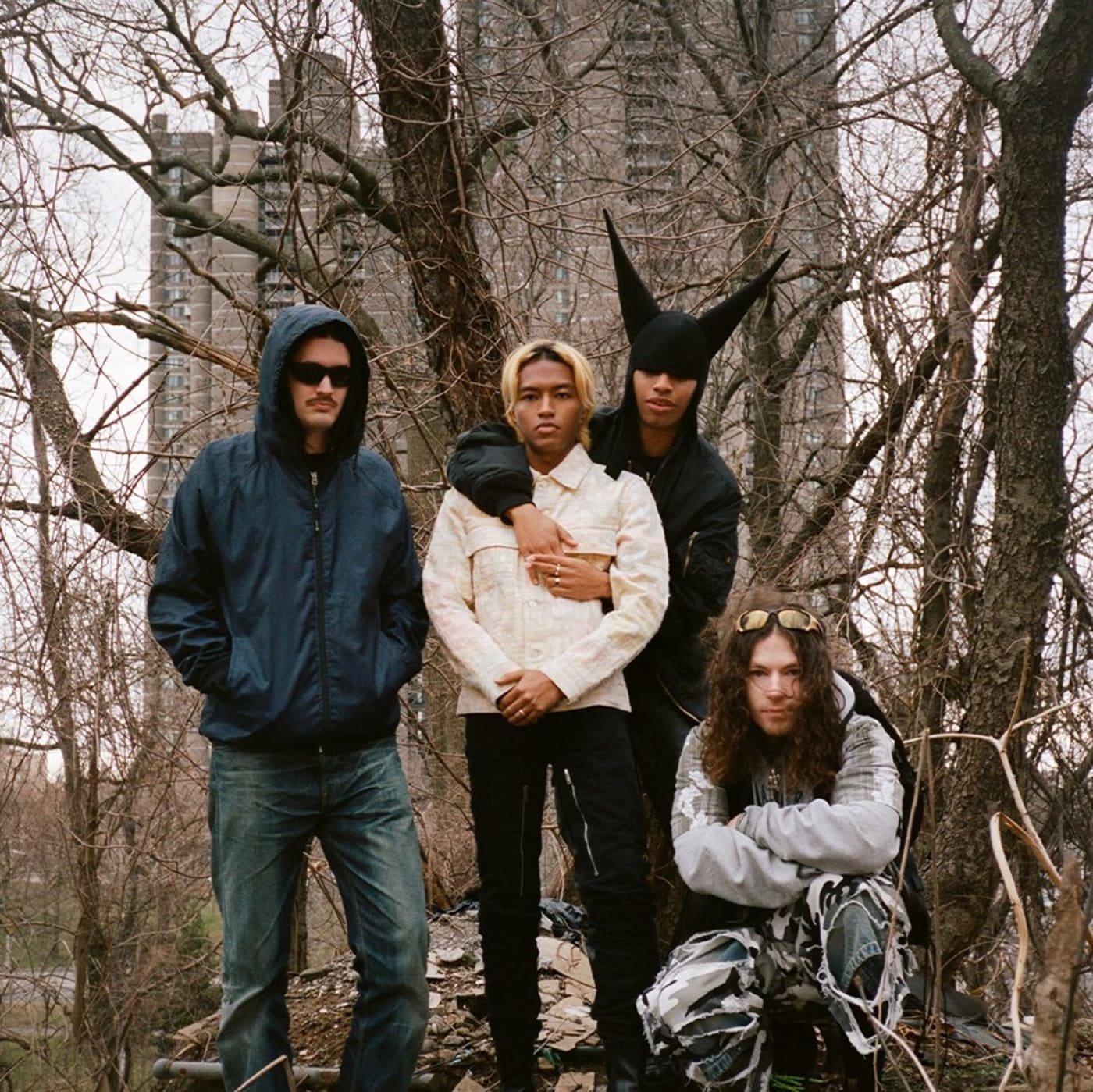
Most artists use album covers to clarify a message, to enhance the feelings they are trying to evoke through their music. The Swedish hip-hop collective, Drain Gang, often use their album covers as an antithetical force to their music’s lyrical bases. Faces are obscured, seemingly random symbols occupy foregrounds and backgrounds in haphazard formations, while any emotion intended to be derived from it is unclear and appears deliberately scrambled. In the same way, the musicians ask their listeners to feel their music first, before attempting to understand it.
Formed in Stockholm in 2013, Drain Gang consists of rappers Bladee, Ecco2k, and Thaiboy Digital, alongside their producer Whitearmor. Bladee (Benjamin Reichwald) and Ecco2k (Zak Arogundade Gaterud) met at school in 2004 and became close friends around the age of 10. Sharing a musical vision, the two first performed together at 13 years old as the grindcore duo Krossad, and then went on to collectively pioneer a new sound in music. Thaiboy Digital (Thanapat Bunleang), having moved with his family from Thailand to Sweden in 2003, was introduced to the two through their producers, allowing the three rappers to create what Bladee would humorously go on to claim is “the new One Direction” in his 2017 track ‘1D’. The collective’s popularity grew in the late-2010s, gaining prominence for their influence of the underground rap scene and experimentation with cloud rap, a genre shaped by ambient, new age music that aimed to introduce a dreamlike atmosphere to traditional trap music. On the meaning of the group’s name, Bladee stated in a 2018 interview with Frankie Dunn for i-D magazine: “Drain is about loss and gain; it could be good or bad — you could be drained of energy or you could drain something to gain energy.” Having sifted through a few different names for themselves, they settled on “Drain Gang” which encompasses their music most aptly, capturing the simultaneous sensation of numbing lyricism and overwhelming melodic production that makes you feel everything and nothing all at once.
This contradiction is sustained across their album covers. Of their three collaborative albums, the second, D&G (2017), boasts a fairly simple album cover, removed from the digital artwork that consumes many of the others in the genre. It features an open mouth resting a metallic pill on the tongue, scoring the group’s initials “DG” within a heart-shaped crest. This confusing fusion of romantic and ominous imagery within what looks like a medieval coat of arms redesigned by a pharmaceutical company plays into the confusion consistent of their album art, despite its deceptively simple appearance. An image of consumption is evoked – of drugs, of love, of identity itself – but whether that consumption is draining you or saving you remains unclear. In line with Bladee’s words, it is likely both.
Bladee’s 2024 album, Cold Visions, revisits this tension, exploring his issues with drug abuse and depression. He released the album on a Tuesday night with no grand announcement or prior promotion, simply releasing the 30-track project into the world. The album cover seems a deterioration of his self-image. Bladee’s artist photo on Spotify shows Reichwald’s face obscured by gothic white and black make-up, long black hair, and a baseball cap that throws his face further into shadow. Surrounding him are neon numbers and symbols edited into the photo against a cartoonish line drawing in the background. He digitally places himself into this visual space of obscure semiotic symbolism, hiding behind layers of clashing masks. A harsh line drawing depicting a face staring right at you, a smaller face positioned below, both haunted by vacant expressions and hollowed-out eyes. Scribbled marks obscure some features of the faces and foreground, while illegible graffiti-style writing occupies the top-left corner. The album appears to be a portrait of the artist, yet you are no longer looking at Bladee’s face, instead you are witnessing an idea of him, filtered through a dozen competing symbols. Themes of paranoia and digital anxiety feature in the album, a return to his earlier, grittier Drain Gang sound, but this time with a harsher production. Throughout the album, Bladee references consumption, reflecting on how addiction has ruined his ability to enjoy daily life. The 14th track, ‘DON’T DO DRUGZ’, delivered in his typical melodic tone against a digital backdrop of noise and curated laughter, warns that “having issues with the drugs” will “make your reality pale.” Despite his attempts at hiding behind meaningless symbols and scribbled lines in the album cover, his lyrics descend into surprising vulnerability.
Extending beyond the album cover art, emotional concealment pervades the use of sampling as well. Bladee’s 2018 track, ‘Be Nice 2 Me’, is his most streamed song, with 65.9 million streams on Spotify alone. Following a distorted warbling of “Drain Gang forever”, the song samples two lines from the 2007 Juno, a film about unplanned pregnancy and the emotional relationships that develop across that journey. The lines where Juno announces her pregnancy to her boyfriend, “So guess what… What? I don’t know” play out, slightly sped up, before the bass drops and the song descends into the rap sound typical of Bladee’s music. The displacement of these lines, once attached to an emotional moment, are now sampled and quickly forgotten at the start of this track, an undermining of the feelings they once embodied. As with the obscuring of his self-portrait in the Cold Visions album cover, it feels as though Bladee is attempting to hide behind this sample, using someone else’s expression of emotions in place of his own, a substitute that is both revealing and concealing all at the same time.
The obsession with digital distortion and an aesthetic of glitching mixed media across the album covers and samples shared between the collective seems a reflection of the post-internet space they inhabit, experiencing a manufactured discomfort with sincerity. However, when paying attention to their lyricism, the musicians should be applauded for the vulnerability they display. The album covers and the lyrics that follow don’t just contradict each other, they collaborate. The visuals obscure, the lyrics reveal, and then the music adds another layer of obscurity just to keep you guessing. The rappers display a constant push and pull between concealment and expression of emotion, all hidden under a layer of artistic distortion: a perfect balance of gain and drain.