
Answers — Bibio and Dorian Concept
By Imogen Eve
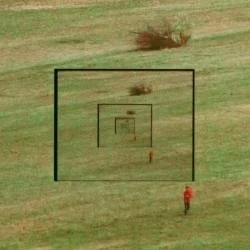
The initial impression I had of Bibio and Dorian Concept’s new album, Answers, was that I should be listening to it in a particular way, i.e. carefully, because it is subtle (it is fully instrumental), and openly, because tracks are ambiguous. For this reason, I listened intently as one track fed into another, like watching moving pictures on a zoetrope, or settling a gaze on a flickering candle flame. The album is a heady mixture of heavy, synthetic textures and field recordings, only rarely including vocals. Each track summons a landscape, often warm in tone, with soft instrumentation. The whole effect is cocoon-like, almost claustrophobic, as if you’re James from James and the Giant Peach, crawling through warm, enigmatic and sometimes freakish environments.
There are a handful of tracks on the album which feel frustratingly repetitive and simplistic. ‘Pigeon Harp’ is the fourth track, and offers a sobering simplicity after the album’s opening three tracks. After the initial twenty seconds of listening, it settles into a guitar loop, after which the track fails to gain any kind of momentum. It is only slightly more interesting for a simplistic layering of electronic elements. Stylistically, it could be a minor track on Bibio’s Sleep on the Wing (2020), in its featuring of scarcely concealed raw folk elements such as the acoustic guitar. Largely, the track feels blunt and unpolished, incongruous with the more complex melding of musical textures in the preceding three tracks. Similarly repetitive and two-dimensional are ‘Jelly Pencil’, or the unremarkable ‘The Unknown’, which feels like a shuffling, watery echo of a track from Aphex Twin’s Come to Daddy (1997), with its stabs of strained human vocals. These tracks amount to a definitive mid-album slump. All this is to say that the first three tracks are more subtle, and although largely pattern-driven, are not so sonically monotonous or strenuous to listen to.
Long-standing fans of Bibio may be excited by ‘Sugar Rain’, which absorbs little of Dorian Concept’s dyed-in-the-wool electronica, instead retaining the sweet, muffled guitar textures of Bibio’s breakthrough album, Ambivalence Avenue (2009). Answers really picks up at the eleventh track, ‘Star Bird’, where, from a skein of musical textures, a creature is allowed to emerge slowly. Through crunching sounds of static, a high, tinny, garbling voice tries to communicate, as though from space. A malicious, curling voice answers back, as does a female vibrato, and violins. Bursts of new sounds keep listeners hooked, waiting for that time when ‘Star Bird’ is born. The song’s fading out makes listeners wonder if we instead took a celestial round-trip to visit him, only to return to where we began, perhaps on Earth. Tracks in Answers are much stronger for creating this kind of narrative arc, a sense of emergence and movement, rather than relying on textures alone.
Dissonant chords in ‘Stratocumulus’ add to the nebulous, ambiguous sound of the album. It builds in the same way as a dance track might, working towards a drop, although this moment doesn’t arrive. Unlike other tracks on the album, ‘Stratocumulus’ retains a tension which is hard to come by in other tracks, although it feels like a missed opportunity to add a radical element which would have marked a kind of ‘break-through moment’ in the album’s final stretch, i.e. a more clearly defined beat, before the album lapses, ending whisperingly with ‘Pomegranate’.
You didn’t imagine the ‘bedroom feel’ production of the album, which was made by the two artists in their separate remote locations across Vienna, Wolverhampton, and rural Wales. Austrian artist Oliver Thomas Johnson (aka Dorian Concept) and Stephen James Wilkinson (aka Bibio) both have roots in the sonic arts of the early 2000s, when the concept of ‘bedroom producer’ was still exciting, enabled by the emergence of DAWs (digital audio workstations). Answers marks a long awaited collaboration and celebration of their shared interest in sonic experimentation. Is the result exciting? Sometimes. More often, tracks feel a little flat, like compromised versions of songs which the artists might have produced more richly by themselves. This begs the question of whether the album might have benefitted from being shorter, with some tracks omitted. Still, tracks like ‘Star Bird’ reveal a more colourful side to the collaboration.